Structural health monitoring (SHM) refers to the automated procedure involving the implementation of a damage detection and characterization strategy for engineering structures. Timely detection of various forms of failures in structures has the potential to greatly reduce the maintenance cost over the lifetime of a structure and may help prevent catastrophic events. At present, the combined advent of low-cost sensor technologies and digital twins, i.e., accurate virtual representations of complex heavy industry assets, have helped in the transition from classical time-based maintenance with scheduled periodic inspections to condition-based maintenance for large-scale structural systems. In general, the combination of parametrized mathematical models with experimental data is crucial to guarantee reliable monitoring of the lifecycle phases of a structure. The inspiration to this work is to circumvent the shortfalls of previous approaches (particularly model-based methodology), which focus on estimating the parameters that minimize the difference between the model response and the new sensor measurements. Ideally, such a methodology presents an inverse-problem approach which is often ill-posed and requires many online model solves and therefore not suitable for real-time damage assessment.
A reliable alternative is provided by data-driven methodologies, where predictions on the state of damage of a structure of interest are achieved by comparing the outcome of physics-based models with new experimental observations using machine learning techniques. To this end, Dr. Caterina Bigoni and Professor Jan S. Hesthaven from the Federal Institute of Technology in Lausanne (EPFL) in Switzerland proposed an anomaly detection approach by adopting mathematical numerical models that can approximate the propagation of acoustic-elastic waves in a structure excited by an active source. Specifically, their goal was to compare the measurements of a network of sensors, placed on the structure, with equivalent quantities of interests obtained from numerical simulations to discriminate between healthy and damaged scenarios. Their work is currently published in the research journal, Computer Methods in Applied Mechanics and Engineering.
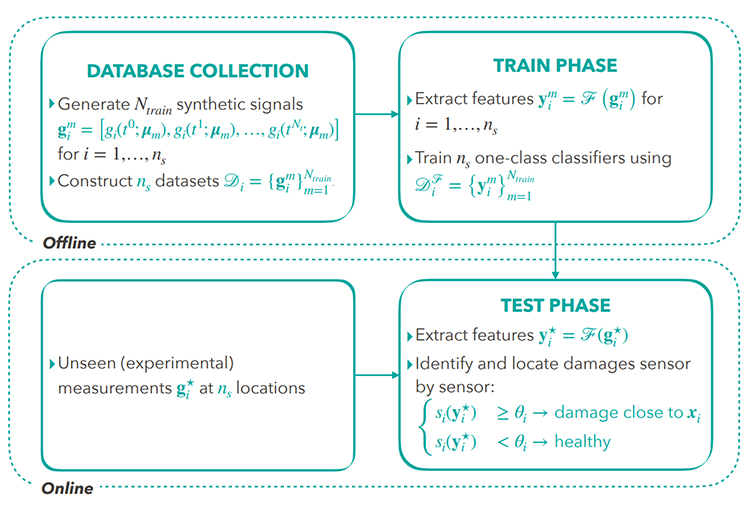
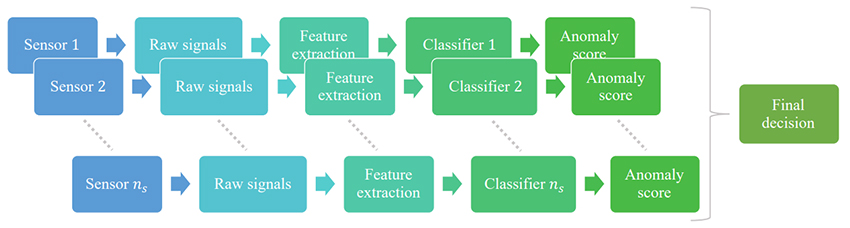
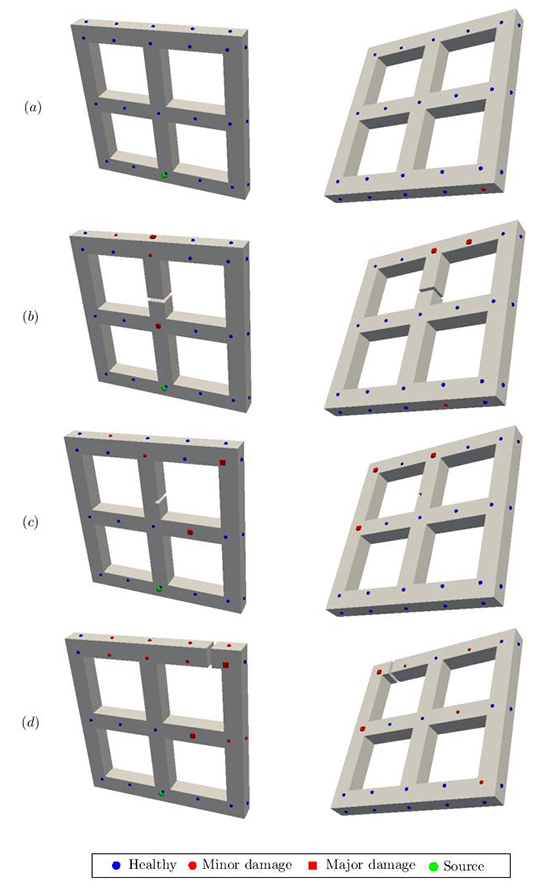
In their approach, the authors focused on applications where the physical system can be modeled by parametric partial differential equations (pPDEs). To begin with, the two scholars constructed an offline synthetic dataset aiming at describing all possible healthy environmental and operational configurations by repeatedly solving a time-dependent pPDE for multiple input parameters, sampled from their probability distributions of natural variation. The collected time signals, extracted at sensor locations, were used to construct multiple databases of healthy configurations. These datasets were then used to train one class Support Vector Machines (oc-SVMs) at such sensor locations to detect anomalies. During the online stage, a new measurement, possibly obtained from a damaged configuration, was evaluated using the classifiers, which ultimately assigned a class label (damaged or undamaged) to each measurement.
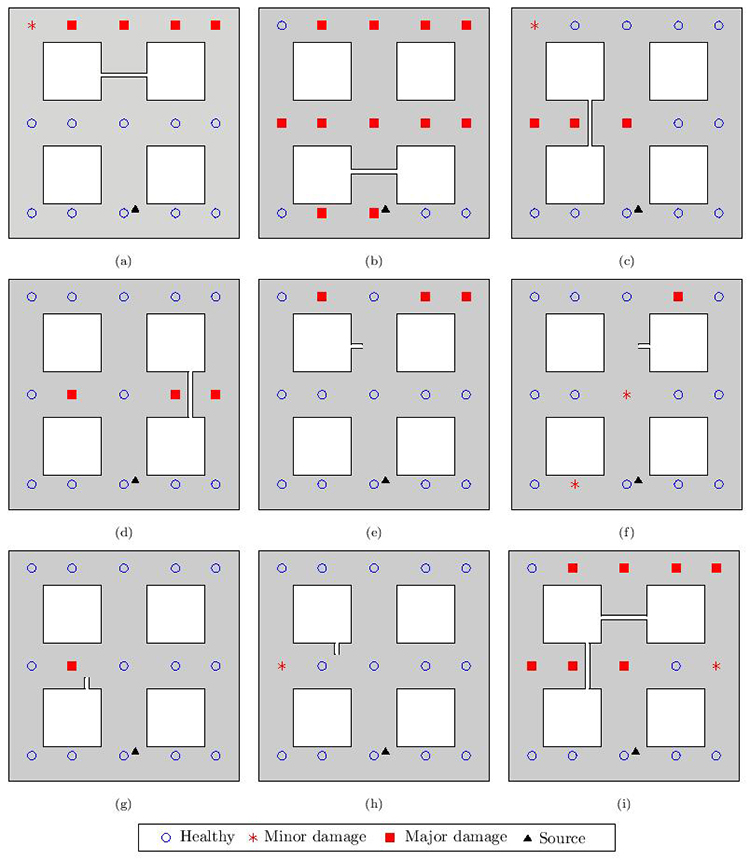
The authors observed that using an anomaly detection strategy based on multiple sensor-based synthetic datasets, generated using guided wave non-destructive evaluation scheme with active sources, detection and localization of damages was possible provided that damages were sufficiently far from the source. Moreover, they reported that the offline–online decoupling of tasks, leveraging model order reduction techniques to overcome the computational bottleneck associated with the many query context, allowed them to compute the sensor response under different operational and environmental conditions in a fast and inexpensive manner.
In summary, the study conducted by Bigoni and Hesthaven presented a data-driven approach for structural health monitoring which leverages the physics-based representation of the structure of interest. In the presented approach, damage detection and localization were carried out on a sensor-by-sensor basis by constructing synthetic training data emulating the sensor response of the structure under the effect of an active source. The results showed that the approach is successful in detecting, localizing, and estimating the severity of damages for 2D and 3D digital twins test problems. In a statement to Advances in Engineering, the authors highlighted that their findings can be applied to other examples; nonetheless, more realistic experiments ought to be carried out within a laboratory environment to further validate their approach.


Reference
Caterina Bigoni, Jan S. Hesthaven. Simulation-based Anomaly Detection and Damage Localization: An application to Structural Health Monitoring. Computer Methods in Applied Mechanics and Engineering Volume 363, 112896.