
The global market for robust, efficient, reliable high power lasers market is likely to be positively influenced by the rising demand from the industrial sector. Recently, the ability to scale the efficiency of high-power oscillators has reduced the need for amplification, thereby reducing the overall cost and system complexity. However, heat load on the active medium remains the biggest challenge in realizing efficient power scaling. Lately, Yb:YAG crystals have attracted significant research attention as a suitable gain medium for overcoming the above challenge. This can be attributed to their remarkable advantages when applied in high-power lasers, including high thermal conductivity, high-quality crystal growth, wide pump band and long fluorescent lifetime.
Yb-YAG crystals have a simple energy level comprising of two manifolds to eliminate the excited-state absorption problem responsible for making the quantum effects the primary source of heat in the crystal. Combining these benefits with appropriate architectures with a high surface-to-volume ratio like thin-disk lasers (TDLs) allows excellent heat extraction. TDLs offer a feasible scalable approach characterized by negligible nonlinearity and relaxed demands for pump diode brightness. Unfortunately, the thin active medium has low pump absorption capability that often results in low optical efficiency, a drawback that can be addressed by redirecting the unabsorbed pump light back to the active medium.
The growing scaling capabilities have resulted in performance improvement of Yb-YAG-based TDLs, including higher optical efficiency and reduction of the quantum defect and heat load. Though such benefits are achievable, they require a narrow absorption peak that could lead to more problems like thermal damage. The introduction of high-power wavelength-stabilized laser diodes based on zero-phonon-line could enable pumping at higher absorption peaks, as has been previously demonstrated. However, it has limitations in terms of efficiency, number of passes and locked spectrum.
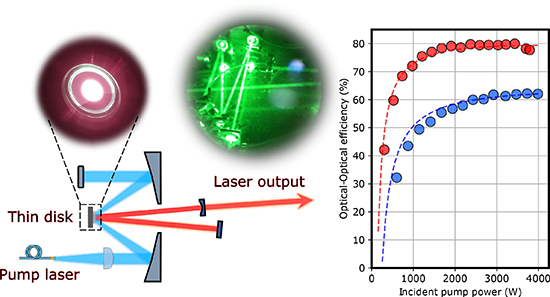
To overcome the above problems, Mr. Abdullah Alabbadi, Dr. Mikhail Larionov and engineer Florian Fink from the University of Stuttgart reported a high-power Yb:YAG TDL with high efficiency pumped at zero-phonon line with 48 passes and fully locked spectrum. A detailed comparison with conventional pumping was conducted to validate the feasibility and applicability of the present pumping at 940 nm. Their research work is currently published in the journal, Optics Letters.
The research team reported a 3-kW TDL with a high optical efficiency of up to 80% when zero-phonon line pumping at 970 nm was employed. This is the highest ever optical efficiency ever to be reported for a TDL. Although the presented TDL exhibited the highest optical efficiency than modern fiber oscillators, it exhibited lower beam quality. Compared with the conventional pumping at 940 nm, it recorded a significant increase in power density capabilities, reaching 9kW/cm2 lower than the damage threshold. The pump power density was about 70% higher than that of conventional pumping.
In summary, the authors reported a remarkable improvement in the TDL performance by pumping at zero-phonon line. Compared with conventional pumping schemes, including those based on zero-phonon line, the present TDL exhibited several benefits, such as significantly higher optical efficiency and higher pump power density handling capabilities, obtained without necessarily having to overheat the active medium. The obtained power density was nearly double the acceptable limit for conventional pumping. In a statement to Advances in Engineering, Dr. Mikhail Larionov, the lead and corresponding author stated that their findings would significantly contribute to the development of a new effective route for improving further the power scaling capabilities without having to increase the size of the pump spot.



Reference
Alabbadi, A., Larionov, M., & Fink, F. (2021). High-power Yb:YAG thin-disk laser with 80% efficiency pumped at the zero-phonon line. Optics Letters, 47(1), 202-205.