The manipulation and usage of gas in water have been made possible. It finds a wide range of applications in environmental protection, microfluidic chips, chemical manufacturing and energy utilization. The possibility of driving underwater bubbles to move directionally and continuously over a given distance via unique gradient geometries has been successfully archived, opening room for more research on this interesting topic. In many cases, however, the gradient geometry is microscope and unsuitable for transporting gas at microscope level because most microscale gradient structures provide insufficient driving force. This makes underwater self-transportation of bubbles and gases at microscopic level a big challenge.
Femtosecond laser technology has emerged as a promising solution to this challenge. Leveraging on its two key features: extremely high peak intensity and ultrashort pulse width, femtosecond lasers have become critical for ultra-precision manufacturing processes in extreme conditions. It is also characterized by non-contact processing, small heat-affected zones and high spatial resolution that are beneficial in designing and modifying wettability of various materials. Thus, femtosecond laser is a viable tool for creating superhydrophobic microstructures on material surfaces, which is essential for realizing gas self-transportation effects at microscopic level.
Herein, a team of researchers from Xi’an Jiaotong University: Associate professor Jiale Yong, Associate professor Qing Yang, Dr. Jinglan Huo, Professor Xun Hou and Professor Feng Chen proposed an innovative strategy for underwater self-transportation of gas bubbles along a femtosecond laser-induced open superhydrophobic surface with a microchannel width less than 100µm. Femtosecond laser processing technique was applied to manufacture hierarchical nano/microstructures on hydrophobic polytetrafluoroethylene (PTFE) substrates. The research aimed at facilitating the manipulation and usage of gas in water. The work is currently published in the research journal, International Journal of Extreme Manufacturing.
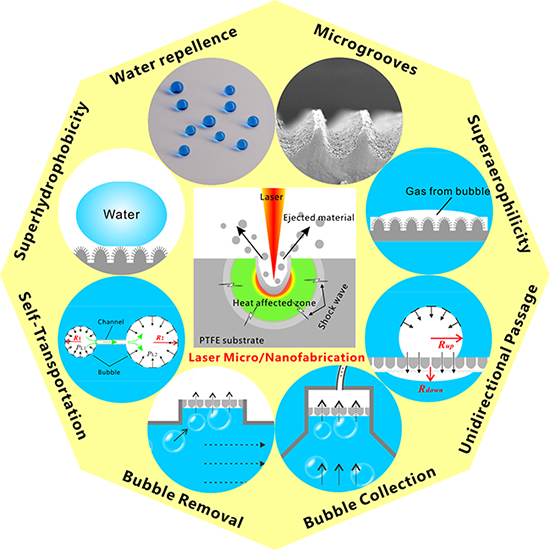
The authors reported that femtosecond laser processing produced PEFE surfaces with remarkable superhydrophobic and underwater superaerophilic properties, resulting in the formation of a hollow channel between the water medium and PEFE surface for easy self-transportation of underwater gas. Moreover, when superhydrophobic microgrooves were connected with two underwater bubbles in different superhydrophobic regions in water, the gas was observed to travel from smaller to larger regions spontaneously along the hollow microchannel. Additionally, through a thin PTFE sheet, gas self-transportation was successfully extended to other functions related to manipulating gases and bubbles in water, such as unidirectional gas penetration, anti-buoyancy gas penetration, and water/gas separation. Furthermore, the Laplace pressure difference was responsible for unidirectional bubble penetration and spontaneous gas transportation processes.
In summary, a strategy for self-transportation of gases along superhydrophobic and underwater superaerophilic open microchannels was reported and demonstrated in this study. Femtosecond laser processing is flexible and capable of drilling open microholes through a thin film as well as endowing solid substrate surfaces with superhydrophobic and underwater superaerophilic properties. This is essential for underwater gas transportation, which does not involve the chemical composition of the gases. As such, the manipulation of gas demonstrated herein is applicable to other gases provided that the gases do not dissolve completely in the provided liquids. In a statement to Advances in Engineering, the authors expressed confidence that their new strategy would aid efficient manipulation of underwater gas to open many new applications in a number of fields, including energy utilization, environment protection and microfluidic chips.


Reference
Yong, J., Yang, Q., Huo, J., Hou, X., & Chen, F. (2022). Underwater gas self-transportation along femtosecond laser-written open superhydrophobic surface microchannels (<100 µm) for bubble/gas manipulation. International Journal of Extreme Manufacturing, 4(1), 015002.