
Current and future advances in technology require state-of-the-art optoelectronic devices like phototransistors and solar cells. In particular, photovoltaic/solar cells offer possibilities for generating renewable energy that could replace conventional energy sources like crude oil. Solar radiation is abundant in nature, and solar panels can be installed almost everywhere to reduce power losses due to transmission. Unfortunately, photovoltaic cell technology still faces the challenge of limited power conversion efficiency (PCE). At present, most photovoltaic cells have a PCE below 21%, while the highest ever reported PCE is 47%. Therefore, developing innovative ways of improving photovoltaic technology is necessary to improve the efficiency of photovoltaic cells and make them affordable to everyone.
The properties of light, the key source for photovoltaic cells, have been extensively studied and have significantly contributed to enhancing the performance of photovoltaic devices. Most importantly, twisted light property, also known as orbital angular momentum (OAM) of light, has received considerable research attention. Twisted light offers new opportunities for improving photogeneration of carriers and photon absorption owing to the advantages of the additional degree of freedom and light-strengthened transition channels. Thus, the interaction of photovoltaic materials with OAM light is worth studying as it could improve solar cell efficiency.
Monolayer transition metal dichalcogenides (TMDCs), specifically 2D monolayer molybdenum disulfide (MoS2), is a suitable platform for studying the properties of twisted light, including its effects on photon absorption capability of photovoltaic cells, due to its remarkable optoelectronic properties. So far, promising results, including high PCE and structural simplicity and flexibility, have been reported. Moreover, single-layer MoS2 exhibits a relatively larger absorption coefficient beneficial for various energy harvesting applications. Despite the remarkable progress, there are no reports on enhanced MoS2 absorption by varying the structural properties of the incident light photons.
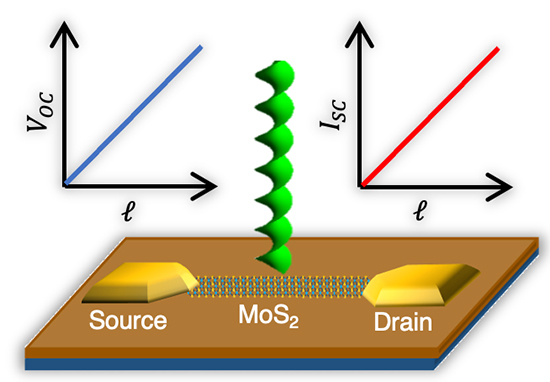
To address the above issue, researchers at National Taiwan Normal University: Mr. Yi-Jie Feng, Dr. Wen-Hao Chang, Dr. Chun-I Lu, Professor Ting-Hua Lu and Professor Yann-Wen Lan in collaboration with Dr. Kristan Bryan Simbulan from the University of Santo Tomas studied the twisted light-enhanced photovoltaic effects. A single-layer MoS2 channel exhibiting photovoltaic properties was excited with twisted light. The effects of varying the properties of incident light on channel absorption were investigated in detail. The work is currently published in the journal, ACS Nano.
The author’s findings revealed that both the open-circuit voltage (VOC) and short-circuit current (ISC) exhibited improvements with an increase in quantized OAM of the incident 532 nm light at fixed optical power. This was attributed to the positive effects of the OAM light that improved the optical absorption efficiency of MoS2. In addition, simultaneous electrical and optical measurements showed that the increase in photocurrent along with topological charge l was associated with enhancing the trion-to-exciton ratio, implying enhancement of the concentration of the photogenerated carriers and the device’s photoresponse. Furthermore, the authors noted that the OAM light may have increasingly utilized the forbidden transitions with increased laser power.
In summary, the feasibility and practicability of using OAM light to enhance photovoltaic effects of photovoltaic devices, such as increased absorption efficiency, was demonstrated. Twisted light improved the efficiency of the channel material in absorbing incident light, which may be due to the improvement in the forbidden electronic transitions. The estimated efficiency improvements were in good agreement with the experiment data. The study findings demonstrated the promising capability of twisted light in energy device application by unlocking the potential of 2D MoS2. In a statement to Advances in Engineering, Professor Yann-Wen Lan, the lead and corresponding author explained that twisted light offers a feasible and efficient alternative approach for improving the photovoltaic performance of energy harvesting devices and will play a crucial role in meeting the high demand for sustainable and reliable energy sources.

Reference
Simbulan, K., Feng, Y., Chang, W., Lu, C., Lu, T., & Lan, Y. (2021). Twisted Light-Enhanced Photovoltaic Effect. ACS Nano, 15(9), 14822-14829.