
Mg-Li alloys exhibit remarkable electromagnetic shielding performance, high specific modulus, low density, among other properties that make them ideal candidates for manufacturing aerospace and automobile parts. Despite the extensive research on Mg-Li alloys, very few studies have investigated and characterized the properties of alpha-based Mg-Li system alloys. This led to the Mg–3Li–3Al–3Zn–1Y alloy design. Zn and Al were added to achieve solid solution and second phase strengthening through different mechanisms. The study of this alloy has significant practical implications in spaceflight and has opened an avenue for the design of other alpha-based Mg-Li alloys with better performance.
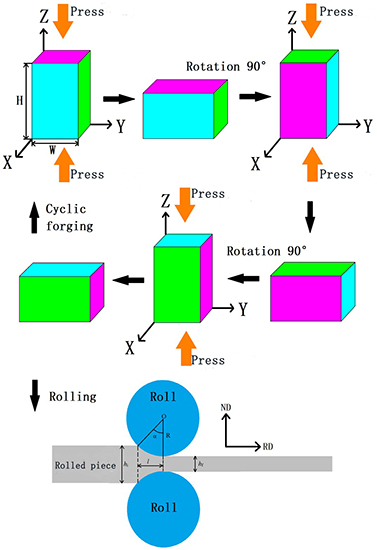
Among the many techniques for preparing Mg-Li alloys, multidirectional forging (MDF) is the most appropriate approach for industrial application. Unlike high-pressure torsion and equal channel angular pressing that are mainly used for small-size samples, MDF is suitable for large samples as it uses conventional equipment. Lately, research has shown that a combination of MDF and rolling (R) (MDFR) can improve some mechanical properties of the resulting magnesium alloys. However, despite numerous studies on the mechanical and structural properties of magnesium alloys fabricated by MDF, there are limited studies on those fabricated by MDFR. This is an important area to investigate because it will provide insights into the properties of the alloys and their deformation and strengthening mechanism and microstructural evolution. Specifically, there is a need to quantitatively investigate the strengthening mechanisms of alpha-based magnesium alloys produced by MDFR and to clarify the bimodal microstructure evolution and forecast the occurrence of serrated flow in these alloys.
To address these urgent needs, a group of researchers from Northeastern University China: Dr. Furong Cao, Mr. Chaofeng Sun, Ms. Huihui Shang, Mr. Chao Xiang and Mr. Renjie Liu fabricated a novel Mg-2.76Li–3Al-2.6Zn-0.39Y alloy using their novel MDFR technique and investigated its mechanical properties, microstructural evolution and strengthening mechanism. The researchers also explored the deformation mechanism and the possible causes of improving ductility and strength in bimodal grain. Additionally, a criterion for elucidating the occurrence of Portevin–Le Chatelier (PLC) effect was proposed. The work is currently published in the journal, Materials Science and Engineering A.
After 6-pass MDF, the research team obtained ultimate strength, yield strength and elongation of 256 ± 4 MPa, 189 ± 5MPa and 38.5%, respectively, for the prepared alloy at a grain size of 7.9 ± 1.9μm. However, an ultimate strength, yield strength and elongation of 275 ±5 MPa, 207 ± 7MPa and 29%, respectively, were reported at a rolling grain size of 6.8 ± 1.1μm. Additionally, this alloy recorded specific strength of 183.58 kN mkg-1 and a specific modulus of 30.04 MN m kg-1. Microstructural examination confirmed the existence of bimodal microstructure suitable for improving the strength and ductility of the alloy. According to XRD analysis, the present alloys comprised Al2Y, Mg2Y, α(Mg) phase, Mg17(Al,Zn)12 and AlLi intermetallic compounds. Additionally, dislocation wall and pile-up were also observed. The alloy also exhibited PLC effect, and the proposed criterion for judging its occurrence was validated based on experimental and break-away stress.
In summary, the fabrication of a novel ultralight Mg-2.76Li–3Al-2.6Zn-0.39Y alloy using their novel MDF and rolling technique and subsequent investigation of its mechanical properties and microstructural evolution are reported in this study. The study elucidated the cause of bimodal grains and reported that the deformation mechanism of MDF was characterized by incomplete dynamic recrystallization and mechanically shearing fragmentation. The contribution of strengthening mechanism to mechanical properties of the alloys were clarified, and the estimated yield strength agreed well with the corresponding experimental yield strength. In a statement to Advances in Engineering, Associate Professor Furong Cao, the first and corresponding author pointed out that their findings will advance the design of high-performance magnesium-based alloys and promote the development of multi-mode forming technique and relevant research.

Reference
Cao, F., Sun, C., Shang, H., Xiang, C., & Liu, R. (2021). Microstructure evolution and mechanical properties in an ultralight Mg-2.76Li–3Al-2.6Zn-0.39Y alloy. Materials Science and Engineering: A, 822, 141680.