
In a recent publication, Dr. Taehyoun (John) Kim from Pegase Avtech in Washington, USA proposed to tackle nonlinear systems with a new technique similar to the aforementioned approach, namely by invoking an analogy to the linear systems with parameter variations. His approach is based on the realization that even without any parameter variation, the nonlinear system undergoes alterations through its nonlinearity consequently generating a characteristically rich solution space. In particular, to avoid the condition-by-condition calculations the author resorted to statistical mechanics and derived an integral form of the Liouville theorem with a uniform probability distribution in the solution space. His work is currently published in International Journal for Numerical Methods in Engineering.
To begin with, the MEPS, though originally developed for linear time-invariant systems, was modified for time-varying cases and applied to find the characteristically rich nonlinear solution space given arbitrary initial or boundary conditions, or system inputs. An integral form of the non-Hamiltonian Liouville equation was derived such that a rich ensemble average of its solutions could cover a broad range of the modal space when a maximum uncertainty is present in the solutions.
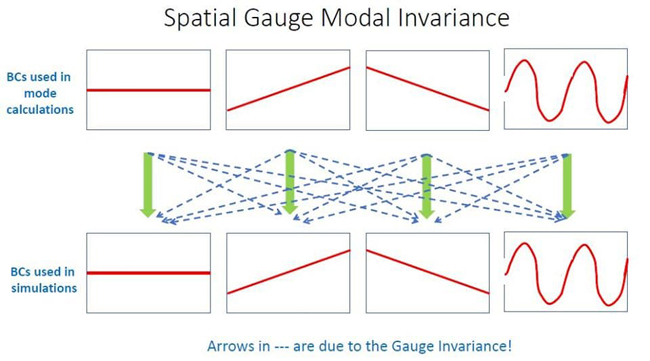
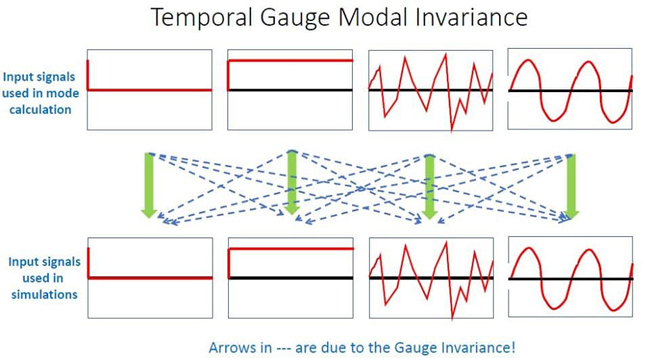
Remarkably, the author found that the MEPS degenerates the integrated Liouville equation into a linear differential equation with the gauge modal invariance (GMI), a new field property analogous to the gauge symmetry of the classical mechanics that allows the vector space to be extended beyond the original initial, boundary conditions, and inputs. Typically, the GMI works both in time dimension – temporal GMI and in space dimension – spatial GMI (see the figures). The researcher was able to show that the characteristically rich nonlinear solution space found herein, if not the nonlinear solutions themselves, satisfies the linearity and obeys the linear superposition. Thus, combining the GMI and linearity it is possible to calculate the rich set of basis modes by taking snapshots of the linear responses at a considerably low computational cost.
In summary, starting with the statistical mechanics approach, adopting the time-varying version of the MEPS and introducing the degeneration transformation (DT), the study introduced a novel theory and scheme to calculate a sub-dimensional solution space of a nonlinear system covering a broad range of initial conditions, boundary conditions, and inputs at a significantly low computational cost. The developed theory and algorithm were demonstrated using a computational model of a two-dimensional incompressible, viscous flow at low Reynolds numbers. In a statement to Advances in Engineering, Dr. Kim highlighted that the applications of the proposed method are numerous and could encompass all areas of nonlinear dynamic systems, for example, nonlinear structural dynamics and aeroelasticity, viscoelasticity and plasticity, incompressible and compressible fluid flows.

Reference
Taehyoun Kim. Finding characteristically rich nonlinear solution space: a statistical mechanics approach. International Journal for Numerical Methods in Engineering 2020; volume 121: page2331–2368.
Go To International Journal for Numerical Methods in Engineering