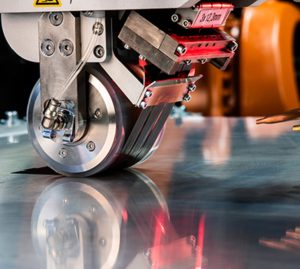
Milling machining removes materials when a cuter advances into the workpiece. In the process, machining vibrations, also called chatter, are induced as a result of the movements between the cutting tool and the workpiece. If not adequately controlled, chatter will seriously affect machining quality and productivity. Moreover, different chatter mechanisms, including regenerative, mode coupling, and frictional chatter, have been reported in the literature. Among these, the regenerative chatter mechanism is often used as the basis of understanding the occurrence of chatter owing to the fact that it occurs earlier in most milling processes and is, therefore, associated with the wavy machining surface that results in cutting force variations during machining processes. To this note, the dynamic behavior of milling processes has been generally described as delay-differential equations problems. Therefore, current and future research of milling dynamics will highly depend on the analysis of delay-differential equations.
Herein, scientists at Shanghai University of Electric Power from College of Energy and Mechanical Engineering: Dr. Xinfeng Dong and Zhongzhu Qiu (Ph.D. Professor) developed an updated numerical integration method for stability analysis of the delay-differential equations in milling processes. This new method is based on the Hermite numerical integration in which the stability analysis is done in accordance with the modulus of the eigenvalue of the transition matrix. The work is currently published in the research journal, Mechanical Systems and Signal Processing.
In their study, the authors started by dividing the tooth passing period of the milling cutter into two periods: free and forced vibrations. The free vibration map between the beginning and end of time was easily achieved. In contrast, the forced vibrations periods were further divided into several time intervals in which the solution of the delay-differential equations for this study was particularly based on the Hermite numerical integration. Eventually, the discrete dynamic map describing the current state after the machining operation and initial state before machining activity was established.
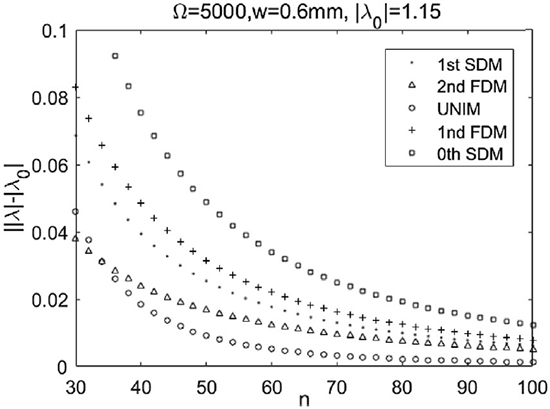
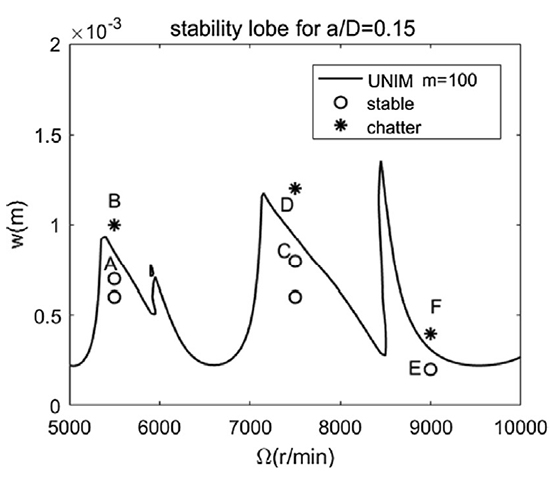
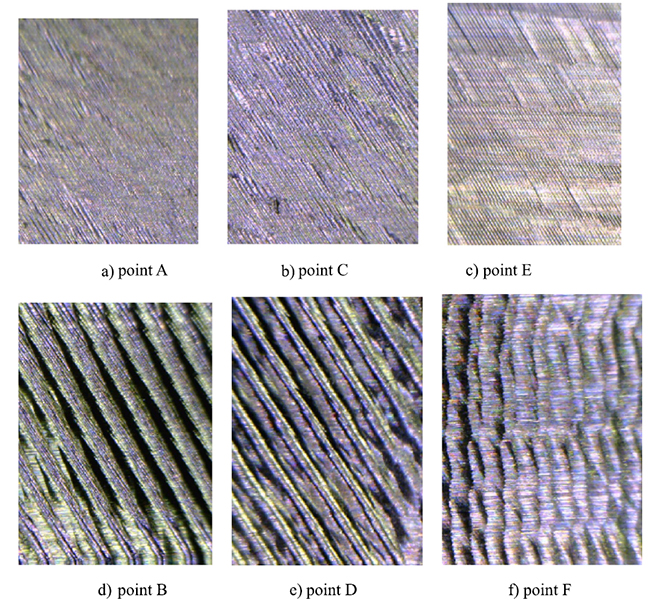
The convergence rate of stability analysis was conducted for a single degree of freedom milling system, and results compared to other methods, including the numerical integration, first- and second-order semi-discretization method (SDM), and first- and second-order frequency-domain method (FDM). Among all these methods, updated numerical integration produced the highest convergence speed and calculation accuracy. Similar comparison results were reported for two degrees of freedom milling systems for the same calculation periods. Furthermore, the feasibility of the updated numerical integration method was validated through a milling experiment. Results showed that stability analysis based on the updated numerical integration method exhibited high calculation speed and accuracy.
In summary, Dr. Xinfeng Dong and Zhongzhu Qiu successfully developed an updated numerical integration method for stability analysis in milling processes. Based on their findings, the proposed method produced higher convergence speed and calculation accuracy than most methods reported in the literature. In a statement to Advances in Engineering, the authors noted that the results produced by their method are valid and would, therefore, allow detailed stability analysis in milling processes.
The research in this paper can provide a strong theoretical support for the efficient and high-precision milling of parts

Reference
Dong, X., & Qiu, Z. (2020). Stability analysis in milling process based on updated numerical integration method. Mechanical Systems and Signal Processing, 137, 106435.