
High-temperature ceramics have gained considerable interest in various applications, the recent one being aeronautical applications. To date, taking advantage of technological advancement, different types of tungsten materials have been developed. In particular, tungsten borides have been researched for high-temperature structural, wear-resistant, and corrosion resistance applications owing to their excellent properties. Moreover, experimental research on tungsten borides has been encouraged to improve their properties and expand their applications to different fields. However, the previous studies focused mainly on the theoretical predictions with limited experimental support.
Among the reported tungsten borides, WB2 have been extensively researched since its discovery several decades ago. Like most tungsten borides, it is synthesized using different methods, including molten salt electrolysis, the solid-state reaction, among others. However, these techniques have several drawbacks that making them unsuitable for fabricating ceramics. Recently, the molten salt synthesis technique was identified as a promising solution to address the above challenges. This method is advantageous in that it provides a liquid phase environment for the reaction process to thrive. It also allows for adequate time for blending the raw materials besides reducing the reaction temperature and energy consumption. Unfortunately, this method has not been thoroughly investigated for the low-synthesis of tungsten diboride materials.
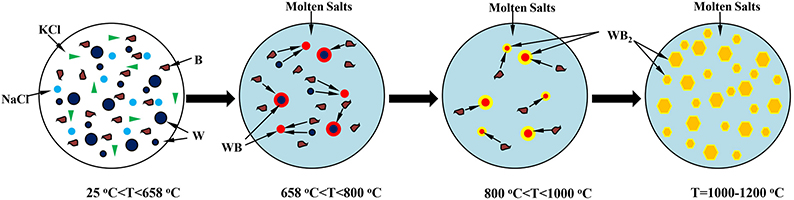
Dr. Ke Ma, Professor Xiangxin Xue, and Associate Professor Xiaozhou Cao from the Northeastern University studied the low-temperature synthesis of tungsten diboride using the simple molten salt method. Mainly, the molten salt synthesis process was explained using two different mechanisms, namely, template formation and dissolution-precipitation mechanism. The main aim was to develop a foundation framework for studying the synthesis processes and properties of ceramic materials. Their research work is currently published in the International Journal of Applied Ceramic Technology.
In their approach, tungsten powder and amorphous boron powder were used as starting materials during the preparation of WB2. The liquid environment, generally associated with molten salt synthesis, was created by adding NaCl and KCl salts. The authors studied in detail the effects of different factors: reaction temperature, reactants to salt weight ratio, and reaction time on the synthesis process. Additionally, the oxidation resistance of WB2 powders was also investigated. Finally, they evaluated the formation mechanism influencing the synthesis process.
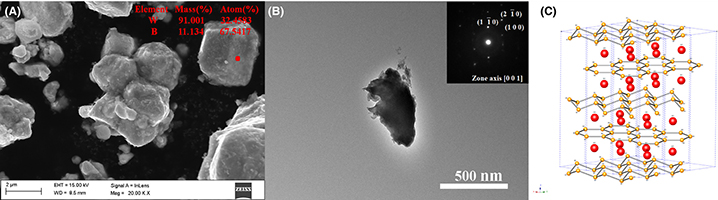
The authors reported a successful synthesis of WB2 powders at a low temperature of 1000 °C. X-ray diffraction and scanning electron microscopy revealed the effects of various factors on the synthesis process. The introduction of the NaCl-KCl salts resulted in a reduction of the synthesis temperature of the WB2 phase, attributed to the accelerated diffusion rates of particles in the liquid-state compared to the solid-state. Additionally, it was noted that at a low temperature of 1000 °C, the formation of the WB2 occurred regardless of the reaction time. An increase in the reaction time led to a transformation of WB phase into WB2 phase with several peaks. A longer reaction time was characterized by coarse hardening. However, the optimum reaction time was reported to be 3 hours, after which a complete single-phase product was formed. Furthermore, the resulting WB2 powders exhibited a hexagonal crystal structure as well as good thermal stability property.
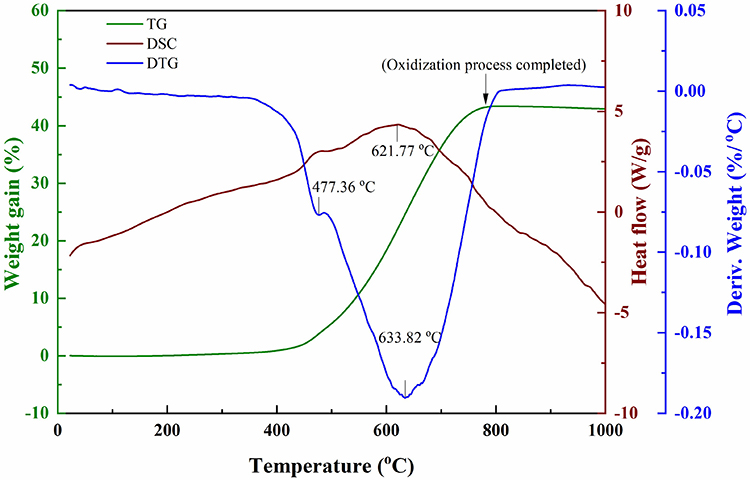
In summary, the study gave more insights into the synthesis of WB2 powders at a low temperature of 1000 °C using a simple molten salt synthesis method. This method outperformed the conventional solid-state reaction technique. Results showed that the synthesis process highly depended on the template formation mechanism. According to Professor Xiangxin Xue, the study provides useful insights on the tungsten diboride powders via a simple molten salt technique. In a statement to Advances in Engineering, he said the results would benefit the scientific community by providing a framework for studying and developing advanced methods for preparing high-performance ceramics.




Reference
Ma, K., Xue, X., & Cao, X. (2019). Low‐temperature synthesis of tungsten diboride powders via a simple molten salt route. International Journal of Applied Ceramic Technology, 17(3), 1177-1182.