
Generally, Metal–organic frameworks (MOFs) are a class of compounds consisting of metal ions or clusters coordinated to organic ligands to form one-, two-, or three-dimensional structures. Credit to their high surface area and the permanent porosity, they build up an ideal platform for developing a new generation of heterogeneous catalysts. Compared to traditional porous materials, MOFs exhibit the exceptional superiority on the chemical variability by introducing the molecular catalysts for desired catalytic reactions. As such, the catalytically active molecules can be directly incorporated into MOFs during the synthesis process by being pre-linked on the organic linkers or post-grafted on the framework after the formation of MOFs. In addition, many MOFs materials have demonstrated superior catalytic activity from the metal ions at the inorganic nodes that could be made catalytically active by removal of the solvent ligands resulting in the coordinately unsaturated metal ion sites as the catalytic centers. However, a fundamental understanding of the nature of such active sites in MOFs is at its early stages, and it still remains unclear how to sterically define and experimentally modify these sites, or how the sites’ activity can be further tailored and improved.
In this context, West Virginia University scientists: Dr. Jiangtian Li, Dr. Terence Musho, Dr. Joeseph Bright and Professor Nianqiang Wu from the Mechanical and Aerospace Engineering Department developed two strategies to modify the thermally stable crystalline UiO-66(Zr) metal-organic framework structure. The two strategies included the functionalization of the organic struts with branched ligands and manual creation of structural defects with unsaturated organic linkers. Their work is currently published in Journal of The Electrochemical Society.
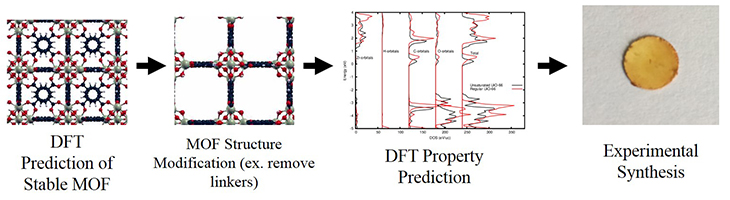
In brief, they started with the synthesis of UiO-66-R MOFs. Next, the organic linker unsaturated UiO-66 MOFs were synthesized following the procedure described by Hupp group. They then characterized the synthesized MOFs by recording the UV-Vis absorption spectra of the as-prepared MOF materials. In addition, organic transformation catalysis testing was carried out. Lastly, density functional theory computational prediction was carried out.
The computational and experimental results demonstrated that functional groups such as -NH2 and -NO2 attached to the main organic strut could modify the electronic environment of the photoactive aromatic carbon and thereby reducing the optical bandgap by 1 eV, consequently improving the photocatalytic activity. In other words, they established that both theoretical and experimental approaches confirmed that the hydrochloric acid treatment modified the MOF structure by desaturating the metal while maintaining the MOF’s crystallinity.
In summary, it was demonstrated that the catalytic activity of MOFs materials was very sensitive to the electronic structure modulation even with very tiny structural variations due to the presence molecular catalytic moiety. Overall, the presented method by West Virginia University researchers offers yet another method to systematically tailor the catalytic activity and selectivity of the MOFs. Altogether, the presented modification demonstrates additional promise for tailoring MOF structures for photocatalysis based applications.

Dr. Terence Musho is an associate professor in the Mechanical & Aerospace Engineering Department at West Virginia University, USA. He received his Ph.D. in Materials Science from Vanderbilt University in 2012. Dr. Musho is also currently a Faculty Fellow at DOE National Energy Technology Laboratory (NETL).
His current research interest focuses on the application and development of first principle materials simulations. More specifically, current research endeavors have been applying density functional theory (DFT) predictions to design and screen new photocatalyst materials for solar-to-fuel conversion processes. A material system of focus has been metal-organic frameworks (MOFs), where recent studies have demonstrated modulation of electrical conductivity properties by inorganic substitution and changing linkers coordination, while still maintaining solar absorption properties and chemical selectivity.
Reference
Jiangtian Li, Terence Musho, Joeseph Bright, Nianqiang Wu. Functionalization of a Metal-Organic Framework Semiconductor for Tuned Band Structure and Catalytic Activity. Journal of The Electrochemical Society, volume 166 (5) page H3029-H3034 (2019).