The global utilization of energy has tremendously increased over the past decades and particularly in the industrial sector. With the current migration from fossil fuels towards sustainable energy infrastructure, there is a great need to advance energy efficiency at the end-user level. For instance, technological advances in the industrial sector i.e. the heat recovery plans can lead to significant primary energy savings.
Herein, Italian researchers: Professor Gianluca Valenti, Mr. Alessandro Valenti and Mr. Simone Staboli from Politecnico di Milano and from a small cleantech enterprise recently illustrated a new thermally-driven air compressor for waste heat recovery, especially in energy-intensive industries. The air compressor generates industrial compressed air by recovering heat from exhaust gases employing readily available technologies adopted from other sectors. The open-loop Brayton cycle operating with air was externally heated to deliver a fraction of the compressed air as a product while the remainder is heated up and processed in the expander, which drove in turn the compressor. The main objective was to test the technical feasibility of the proposed system. The work is published in the journal, Energy Conversion and Management.
The novel system comprised of a single- or two-stage turbocharger and a recovery heat-exchanger. A case study of an existing container glass manufacturing plant was simulated in diverse conditions to validate the study. The glass plants comprised of three major areas: the batch house for handling the raw materials to the furnace, the hot end for annealing ovens and forming machines and the cold end for product inspection and packaging. Only the two-stage configuration was considered for simulation because it is exclusively driven by heat recovery power to attain higher pressures desirable for energy-intensive industries.
Results showed clearly that the system could be realized with mature technologies transferred from other sectors such as the single- and two-stage turbochargers from marine internal combustion engines and heat exchangers from the Oil&Gas sector yielding promising performances. For instance, 2342 m3/h of compressed air at a pressure of 800 kPa was produced from 12000 m3/h of exhaust gas at 560 °C. Among the factors observed to affect the performance of the model, the ambient air condition and the furnace load were crucial considering the effects of air densities that was higher at cold ambient temperatures and lower at hot temperatures. Also, higher furnace load increased the waste heat recovery thus improving the mechanical power of the expanders. Additionally, the inter-cooling power was always lower than half of the waste heat recovery.
It was noteworthy that the gross and net equivalent electric efficiencies obtained using this proposed system were similar with those of conventional heat recovery power plants in the literature. On top of this, further measures and considerations were suggested to improve the performance of the proposed plant. This included but not limited to employing the hot air from the expander as preheated combustion air for minimizing fuel consumption or for cogeneration applications.
Based on the findings, the proposed system exhibited several advantages in terms of greater safety, higher simplicity, smaller footprint and lower cooling load as compared to the conventional waste heat recovery power plants. Therefore, Professor Gianluca Valenti in a statement to Advances in Engineering highlighted “the real need for new, safer and cheaper technologies because today waste heat recovery is limited by the quite long return on the investment of conventional plants. Our new idea has caught the interest of a large Enterprise and, hence, we hope to able to show a pilot plant within the year”.

Dr.-Ing. Ekrem Oezkaya has been a Research Fellow at the Institute of Machining Technology at TU Dortmund University since 2011. His research interests are in various interdisciplinary fields, such as machining and manufacturing processes in combination with FEM, CFD and FSI simulations and mathematical solutions and the investigation of modern difficult to machine materials.

Milan Bücker, M.Sc. has been a Research Fellow at the Institute of Machining Technology at TU Dortmund University since 2017. While he also conducts investigations on the machinability of hard-to-cut steels, his main field of research is the development of tools and processes for the machining of nickel-base alloys.

Prof. Dr.-Ing. Prof. H. C. Dirk Biermann is the director of the Institute for Machining Technology at the Technical University of Dortmund. His research areas cover all relevant machining processes and the information technology environment in machining. In addition, various modelling concepts, as well as optimization in production technology are the focus of his scientific work, which are elaborated in direct cooperation with partners from industry and academia.
Reference
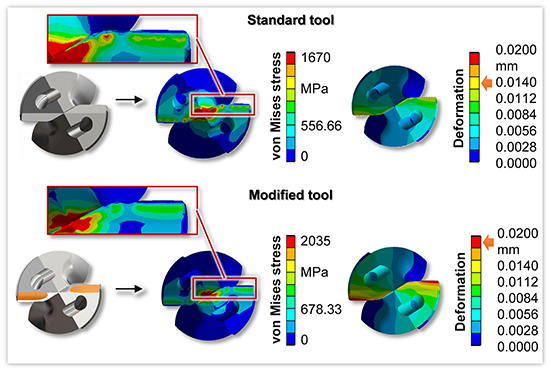
Ekrem Oezkaya, Milan Bücker, Dirk Biermann. Simulative analyses focused on the changes in cutting fluid supply of twist drills with a modified flank face geometry. International Journal of Mechanical Sciences; volume 180 (2020) 105650.