Fluid-solid interaction problems are prevalent in various engineering fields. As such, potential numerical methods have been researched to mitigate the effects of fluid-solid interaction problems. At present, fluid-solid interaction problems can be classified into two based on the continuity of the solid: between fluids and continuous solids and between fluid and discontinuous solids. However, simulation of fluid-solid interaction problems between the fluid and discontinuous solids considering the large movements of discontinuous solids is challenging, mainly due to the drastic and arbitrary changes in the fluid domain. Recently, a combination of computational fluid dynamics and discontinuous methods, i.e., the discrete element method, has been identified as a promising solution. However, these methods have not produced the desired results due to several drawbacks, such as the inaccurate setting of the boundary conditions between the fluid and solids.
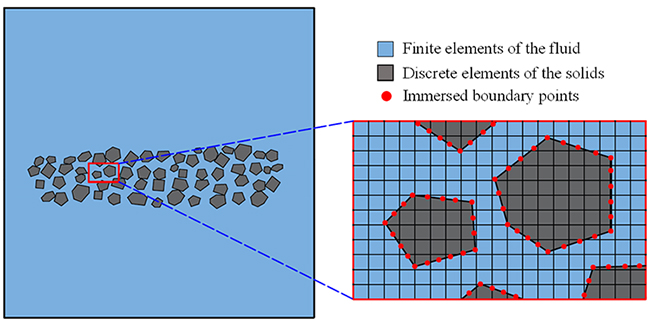
Resolved computational fluid dynamics and the discrete element methods (CFDEM) have exhibited great potentials for accurately simulating the kinetic characteristics of solid bodies and fluids, considering the arbitrariness of body movements. However, the large movement of solids makes it difficult to accurately generate fluid mesh since the discontinuous solids are immersed in the fluids. Based on recent reviews, this problem can be effectively addressed by utilizing the immersed boundary method (IBM) to solve complicated solid boundary problems. Equipped with this knowledge, a team of Hohai University researchers: Dr. Jia Mao, Professor Lanhao Zhao and Dr. Xannan Liu, in collaboration with Dr. Eldad Avital from the Queen Mary University of London, presented a resolved combination of the computational fluid dynamics and the discrete element method (CFDEM) for simulating the interaction between the fluid and the discontinuous solids with large movement. Their work is currently published in the International Journal for Numerical Methods in Engineering.
In their approach, the research team employed several techniques to address the challenges above. First, a discrete element method based on the Lagrangian description was used to model the motion of the discontinuous solids, whereas the fluid flow governed by Navier-Stokes equations was simulated using fixed grids based on the Eulerian framework. Most importantly, the immersed boundary method was used to address the key challenge of representing the moving interfaces between the fluid and solids and calculate the fluid-solid interaction forces. Moreover, the partitioned method was used to solve the coupled system in an iterative way to achieve the desired strong coupling effects. Lastly, the convergence and stability of the proposed methods were verified.
Results showed that the proposed resolved CFDEM method exhibited significantly improved convergence and stability. Compared with the unresolved CFDEM method, the current method is capable of accurately simulating the interactions between the fluid and discontinuous solids with arbitrary shapes and large movements. Moreover, another breakthrough was in the accurate calculation of the fluid flow in fixed grids with high resolution. Furthermore, it was worth noting that fine fluid mesh around the solids, coupled with several iterations, are the core ingredients for obtaining high resolution and strong coupling effects. The feasibility of the new approach was successfully validated by calculating well-known benchmark examples, in which good agreements were obtained. The authors believe their study present important insights that would lead to the development of more advanced methods for solving the fluid-solid interaction problems.


Reference
Mao, J., Zhao, L., Liu, X., & Avital, E. (2019). A resolved CFDEM method for the interaction between the fluid and the discontinuous solids with large movement. International Journal for Numerical Methods in Engineering, 121(8), 1738-1761.
Go To International Journal for Numerical Methods in Engineering