In the aerospace or civil engineering industries, effective structural integrity management of critical assets has been improved based on preventive measures such as earlier detection and characterization of structural damages for proper actions. This explains the recent increase in the research works involving non-destructive and structural health monitoring techniques. It is rather obvious that conventional linear ultrasonic methods have reached their limit regarding the detection of small localized damage. This underpins the current research effort in the field of nonlinear ultrasonics, where the weak nonlinear behavior introduced by structural damage generates new frequency components (higher harmonics), that can be exploited for damage detection and characterization.
Generally, localized damages can be mainly grouped as fatigue cracks and delamination where the nonlinear response is due to contact acoustic nonlinearity. The mechanism involved here is well documented in literature based on various theoretical models. For example, a traction law describing the relationship between the stress and the relative displacement at the interface is widely used to model the ultrasonic response of an interface. This approach is convenient because it is amendable to analytical resolution using a perturbation analysis, contrary to other discontinuous interface models such as unilateral contact.
Recently, Australian scientists presented a novel analytical approach for modeling plane-wave scattering at a plane interface characterized by either linear or nonlinear traction law. Dr. Philippe Blanloeuil (Postdoctoral fellow) and Professor Chun Wang from the University of New South Wales in collaboration with Francis Rose from Defense Science and Technology Group and Martin Veidt from the University of Queensland decomposed the scattering field into two contributions referred to as Mode I and Mode II contributions. Consequently, the scattering problems for linear springs were also reduced to an explicit analytical solution involving two unknows. Their work is published in the Journal of Sound and Vibration.
Unlike the conventional approaches that involved the numerical solution of four unknown variables, this approach is rather simple and advantageous as the scattering decomposition reduces to determining two unknows: tangential and normal components that can be solved analytically. Furthermore, the perturbation analysis that rely majorly on the preceding decomposition led to successive approximations that could as well be solved analytically. This resulted in the formulation of first analytic formulae for nonlinear wave scattering at the nonlinear interface. The formulas were effective compared to the computational results based on the finite element method. The excellent agreement observed highlighted the practical value of the analytical formulas.
As proof of the concept, the authors used the same nonlinear traction law to describe the interface response to validate the practicability of the approach. Analytical solutions were compared to numerical data obtained from the finite element method. Interestingly, an excellent agreement was reported for both linear and nonlinear scattering responses. In a statement to Advances in Engineering, Dr. Philippe Blanloeuil, the first author observed that the analytical formulas can be applied in the evaluation of the effects of various parameters such as the compressive load, amplitude, frequency and incidence wave angle to achieve the desired optimal conditions of the particular application. Therefore, the proposed novel approach will offer practical value in parametric studies of nonlinear scattering at the contact interface.
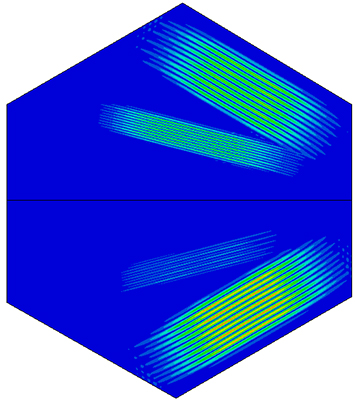
Figure legend: Displacement field after interaction with a contact interface obtained from Finite Element simulation”. The analytical solution derived in the paper directly the amplitude of each wave seen in the FE simulation, at the incident frequency and its higher harmonics.

Professor Wang is the Head of the School of Mechanical and Manufacturing Engineering and an elected Fellow of the Academy of Technological Science and Engineering (FTSE). He joined UNSW in 2016 as a SHARP professor in recognition of his world-leading research and leadership. Previously he held the appointments as the Head of Advanced Composites Technologies at the Defence Science and Technology Organisation between 1995 and 2009, and the Director of the Sir Lawrence Wackett Aerospace Research Centre at RMIT University between 2009 and 2016. He received his bachelor’s degree from Huazhong University Science and Technology in 1985 and PhD from the University of Sheffield in 1991, where he carried out his post-doc research until 1993.
He serves on the Editorial Advisory Boards of a number of professional journals, including Composites Science and Technology, Composites Part A, International Journal of Adhesion and Adhesives, and Fatigue and Fracture of Engineering Materials and Structures. He also served on the ARC College of Experts (2013-2015), as the Chair of the National Committee on Applied Mechanics (2013-2015) and President of the Australian Fracture Group. He has chaired and co-chaired a number of international conferences, including the 11th International Fatigue Congress (Melbourne Australia, 2014) and the 22nd International Conference on Composite Materials in 2019.

Dr Philippe Blanloeuil is a postdoctoral research fellow in the School of Mechanical and Manufacturing Engineering. He obtained his Ph. D in 2013 from the University of Bordeaux in France. During his Ph D, he worked on nonlinear acoustics in view of non-destructive testing. This work focused on the understanding of the contact mechanisms involved in the acoustic nonlinearity at a crack interface. From 2013 to 2016, he worked at the University of Queensland in Brisbane, first as a research officer for the CRC-ACS (CRC for Advanced Composite Structures) and working on ultrasonic SHM (Structural Health Monitoring).
From June 2016, he has been working as a postdoctoral research fellow on an ARC Discovery Project focusing on nonlinear acoustics for SHM, in view to develop a baseline free detection technique. He kept working on this project when he joined RMIT University in Melbourne in April 2016, where he also carried out experimental studies for the Ford Motor Company, evaluating different Nondestructive Evaluation (NDE) methods for composite materials.
Philippe is now working at UNSW as a research fellow, and his current research activities are focused on linear and nonlinear ultrasonic methods for NDE and SHM. The research aims to understand and exploit particular wave interactions with various types of defect in order to detect and characterize damage, and relies on theoretical, numerical and experimental work.
Reference
Blanloeuil, P., Rose, L., Veidt, M., & Wang, C. (2019). Analytical and numerical modelling of wave scattering by a linear and nonlinear contact interface. Journal of Sound and Vibration, 456, 431-453.