
Radiotherapy and chemotherapy are the leading cancer treatment methods. Unfortunately, recent studies have established that certain forms of ionizing radiation and chemotherapeutics (mostly oxaliplatin and anthracyclines) can lead to immunogenic cell deaths (ICD). ICD process is characterized by the exposure of calreticulin on the cell surface, autophagy of the tumor cells and the release of mobile B1 protein and adenosine triphosphate (ATP) due to the metabolism processes within the tumor cells. These events escalate the antitumor immune response in the body. In most cases, however, the resultant immune responses after radiotherapy or chemotherapy may not control the tumor metastases sufficiently due to poor tolerance of individuals to these treatment methods and differences in individual immunities. Thus, strengthening immune reactions due to radiotherapy and chemotherapy is desirable to reduce the required radiation and drug dose by enhancing antitumor efficacy.
Immune adjuvants could strengthen antigen processing and robustness of antigen-presenting cells to improve antigen immunogenicity. Since tumor-based antigens are common in cancer cells post ICD, introducing immune adjuvants during the therapies has proved to be effective in enhancing antitumor therapeutic outcomes. Notably, local injections are commonly used to administer immune adjuvants to minimize the associated side effects like cytokine storms. However, since clinical radio/chemotherapies are repeatedly applied with low individual doses, it is not feasible to administer immune adjuvants via local injections for each treatment dose. Hydrogels have drawn significant attention as drug reservoirs for a sustainable administration of therapeutic agents within cancer cells for enhanced treatment owing to their impressive biocompatibility. Specifically, smart hydrogels exhibit an enhanced response to both internal and external stimuli. However, existing hydrogel systems fail to achieve ICD triggered release of immune adjuvants efficiently.
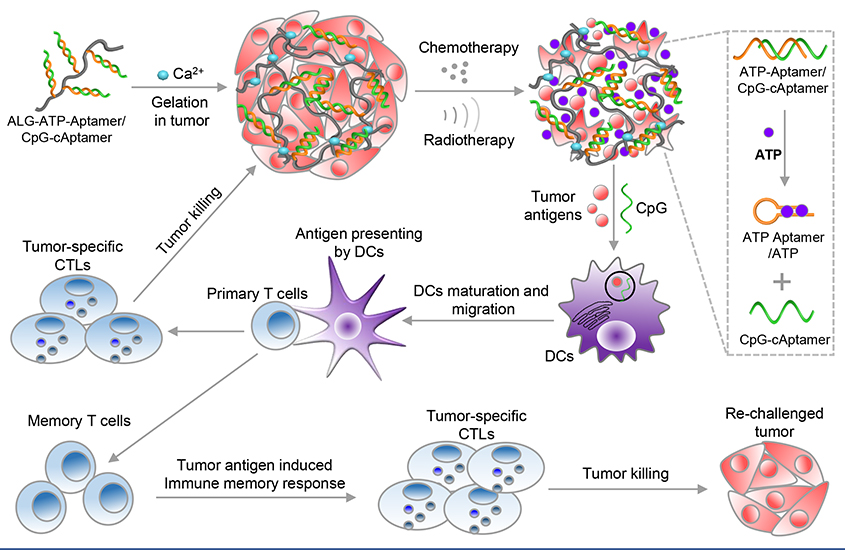
In an effort to address this problem, a group of researchers from Soochow University: Dr. Lele Sun, Dr. Fengyun Shen, Professor Longlong Tian, Dr. Huiquan Tao, Mr. Zijian Xiong, Professor Jun Xu, and led by Professor Zhuang Liu designed and developed a smart hydrogel for efficient release of immune adjuvants in response to repeated administration of ICD-inducing radio/chemotherapies to strengthen the antitumor response. In their approach, ATP-specific aptamer (Aapt) was conjugated with sodium alginate (ALG) to facilitate the formation of the desired tertiary structure. The resulting structure was then hybridized with immunoadjuvant CpG oligonucleotide (CpG ODN), a single DNA strand, to ensure competitive binding between the ATP and the ATP-specific aptamer. The ATP-responsive smart hydrogel was expected to facilitate immune stimulation synchronized with low-dose repeated low-dose chemo/radiotherapies. The work is currently published in the journal, Advanced Materials.
Results showed that upon injection into the tumor, alginate-based hydrogel conjugated with hybridized Aapt/CpG with long tumor retention was formed in situ. During the X-ray-triggered radiotherapy or oxaliplatin-based chemotherapy, the induced ICD tumor cells could trigger ATP release, which competitively binds with Aapt to activate the release of CpG further. The immune adjuvant CpG would then strengthen the antitumor immunity after the ICD-inducing therapies by significantly boosting the immunogenicity of tumor-associate antigens. This also improved its efficacy not only in eliminating the established tumors but also the associated immune memory. Furthermore, it was noted that the triggered antitumor immune responses could effectively suppress distant tumor metastases by synergizing with immune checkpoint blockades.
In summary, an in-situ ATP-responsive smart hydrogel was constructed to enhance antitumor immune response efficacies of repeatedly administered radio/chemotherapies of low individual doses. Its advantages include its unique ability to facilitate the release of immune adjuvant synchronized with radio/chemotherapies applied over a long period with low individual doses. It proved a viable candidate for achieving a remarkable synergistic therapeutic response in eliminating established tumors and suppressing the re-challenged ones owing to its long-term immune memory. The strategy was coherent with clinical practices involving multiple applications of ICD-inducing therapies to reduce therapeutic outcomes while minimizing the potential side effects. In a statement to Advances in Engineering, Professor Zhuang Liu, the lead author said that the ATP-responsive smart hydrogel is a promising candidate for clinical translation as it could improve the therapeutic response of exiting cancer therapies.


Reference
Sun, L., Shen, F., Tian, L., Tao, H., Xiong, Z., Xu, J., & Liu, Z. (2021). ATP‐Responsive Smart Hydrogel Releasing Immune Adjuvant Synchronized with Repeated Chemotherapy or Radiotherapy to Boost Antitumor Immunity. Advanced Materials, 33(18), 2007910.