Corrosion resistance of reinforced concrete structures in marine environments dominantly depends on the transport capacity of chloride ions, as well as the corrosion rate of reinforcing bars in concrete. Consequently, the diffusion behavior of chloride ions in concrete has attracted the attention of many researchers. Generally, if the reinforced steel bars in concrete structures are attacked by chloride ions and begin to rust, they are considered to have failed. Normally, the diffusion of chloride ions in concrete is analyzed by solving the diffusion equation based on Fick’s law. In the equation, the diffusion coefficient is assumed to be constant; however, novel studies have shown that corrosion damage could take place in concrete due to the formation of Friedel’s salt during the diffusion process. The evolution of corrosion damage not only causes the diffusion coefficient to be a function of time, but also speeds up the migration of chloride ions. This can decrease the durability of concrete structures. Nonetheless, few related researches have been reported.
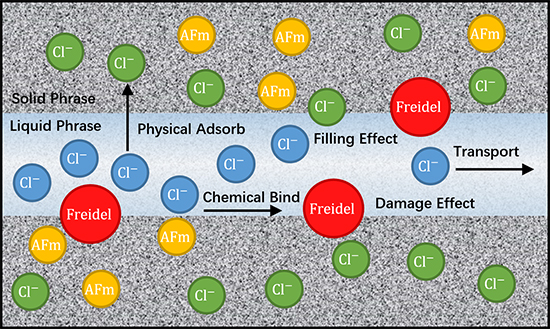
It has been recently established that physical adsorption, chemical reaction and the pore structure are totally different in long-term and short-term cases. This has been hypothesized to be the reason why there exist differences between the diffusion coefficients determined by the natural diffusion test and rapid chloride migration test. On this account, researchers from the Ningbo University, China: Dr. Hui Xu and Professor Jian-kang Chen determined the chloride diffusion coefficient freshly by considering not only the chemical reaction and physical adsorption, but also the pore structure variation due continued hydration and damage evolution. Their work is currently published in the research journal, Construction and Building Materials.
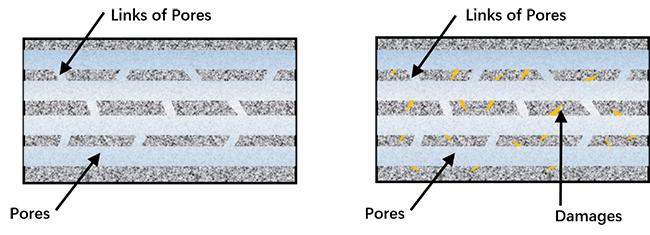
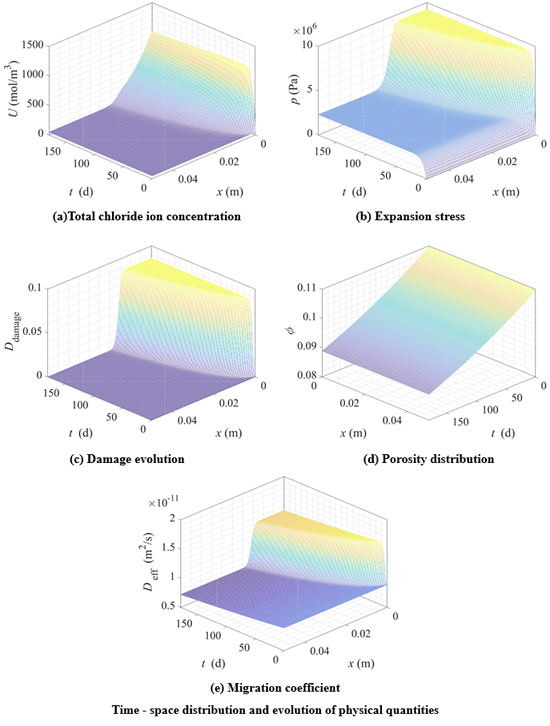
In their approach, close attention was paid to establish the quantitative relation between the chemical reaction rate and the damage evolution, as well as the effect of damage evolution on the chloride ions migration. One-dimensional nonlinear partial differential equations with variable coefficients were proposed. Owing to the difficulty in solving the equation analytically, a numerical method was adopted instead. The feasibility of the model was illustrated by comparing the experimental data.
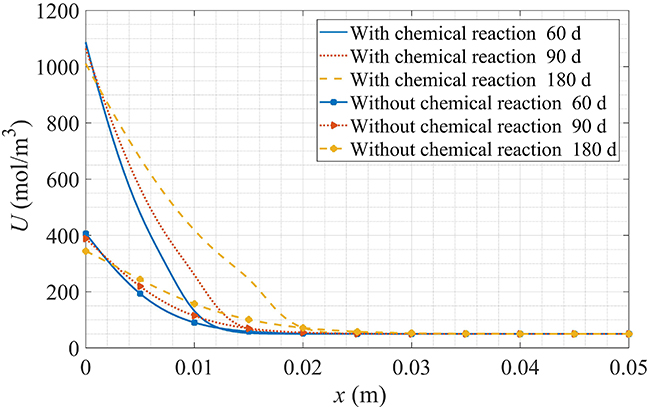
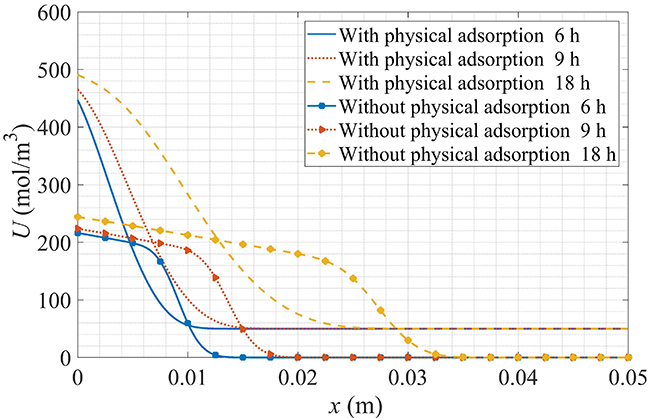
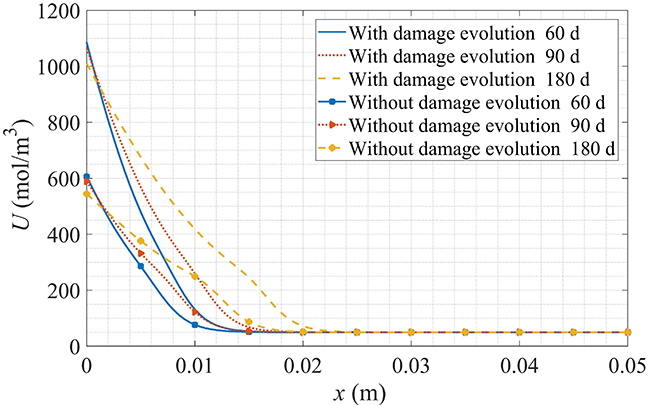
The authors reported that their model could account for the chemical reaction, physical adsorption, continued hydration, and damage evolution. Moreover, it was seen that based on the numerical results, if the influence of damage evolution was not considered, the results of chloride ions transportation might be significantly undervalued, especially in the natural transportation of chloride ions in concrete materials.
In summary, the study presented a new theoretical model for the Rapid Chloride Migration test. In the proposed numerical model, the novel equations were numerically solved via the finite difference method, and were in good agreement with the experimental data presented in literature. Overall, compared to the natural diffusion test, the continued hydration, chemical reaction and damage evolution were seen not to cause a significant difference in the transport behavior of chloride ions in the RCM. In a statement to Advances in Engineering, Professor Jian-kang Chen pointed out that their approach was able to show that corrosion damage could significantly affect the diffusion of chloride ions.


Reference
Hui Xu, Jian-kang Chen. Coupling effect of corrosion damage on chloride ions diffusion in cement-based materials. Construction and Building Materials, volume 243 (2020) 118225.