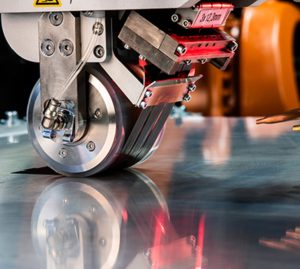
Additive manufacturing (AM) is a transformative and fast-growing industrial approach to production made possible by the transition from analog to digital processes. It uses 3D scanners of computer-aided-design software to deposit materials layer by layer to generate complex shapes and geometries with high precision. Due to its capability to increase production efficiency by reducing material usage and reducing manufacturing steps, AM has drawn significant research attention as a promising alternative to conventional manufacturing processes like casting. Among the available AM techniques, laser bed powder fusion (LBPF) is the most commonly used in fabricating metallic components. The laser beam melts down the powder layer by layer until the desired shape is achieved.
Despite the extensive research on LBPF, most metallurgical studies focus on manufacturing only one material, such as maraging steels, aluminum alloys and nickel-based alloys. In addition, the potential production of hybrid materials by using a conventionally formed metal as the base material followed by printing the second material on top of the base material has also been demonstrated, though sparsely researched. Lately, there has been a growing interest in using the LBPF technique to manufacture dual-parts by incorporating two different powders during production. This approach provides the benefit of utilizing the combined physical and mechanical properties of the two metals as well as the ability to deposit metallic coating over another metal. The strong bonding between the alloying materials is reportedly enough for different applications. Nevertheless, despite the remarkable research progress, dual-metal LPBF processing of iron and cobalt-based alloys remains underexplored.
To fill this research gap, researchers from the University of New Brunswick: Dr. Kanwal Chadha, Mr. Jubert Pasco and Professor Clodualdo Aranas Jr. together with Dr. Yuan Tian from Voestalpine Additive Manufacturing Centre Ltd. performed a dual-metal LPBF of maraging steel and cobalt-chrome molybdenum-based superalloy using an EOS M290 machine. Also, an electron backscatter diffraction analysis was used to describe the microstructural evolution and ideal orientations of the dual-metal material. Specifically, the three analyzed sections included iron-based alloy area, cobalt-based alloy area and the interface between the cobalt and iron-based alloys. The materials selection was strategic to ensure that both alloys benefited from a single AM strategy. Their research work is currently published in the journal, Materials Characterization.
The results revealed that the cobalt-based material formed a strong <110> || building direction (BD) fiber texture with 38.5% BCC and 45.5% FCC and a weak <111>||BD fiber texture. On the other hand, the iron-based alloy generated strong <111>|| BD and <100>|| BD fiber textures. Additionally, the two alloys fused without mixing at the interface and the texture at the interface changed from <100>||BD at the bottom close to maraging steel to <110>||BD at the top close to the cobalt-based material section. An intensity factor of 11.3% was recorded at the interface, which was lower than that of the cobalt-based material sections (11.4%) and iron-based alloy (21.3%). This was attributed to the high randomness of the interface compared to the individual alloys. It was worth noting that the differences observed in the solidification texture of the two alloy materials were due to the growth directions preference of the BCC and FCC crystals.
In a nutshell, the ideal orientations of a dual-metal material comprising iron and cobalt-based alloys were analyzed in this study. The diffusion calculations revealed a negligible diffusion depth at the interface of the two alloys, which is critical in preventing the formation of detrimental intermetallic that can initiate cracks and cause failure. In a statement to Advances in Engineering, the authors explained the study findings could be used to effectively control the texture of the dual-metal materials manufactured via the LPBF process by optimizing their mechanical and physical properties while eliminating unwanted solid solutions along the interface to minimize failure risks.
Reference
Chadha, K., Tian, Y., Pasco, J., & Aranas, C. (2021). Dual-metal laser powder bed fusion of iron- and cobalt-based alloys. Materials Characterization, 178, 111285.