Boiling is among the heat transfer mechanisms commonly used in practical applications. The theoretical description of boiling relies on numerous factors: the influence of chemical and physical surface properties, system pressure and the effects of the temporal and spatial scales. These features have made experimental studies of boiling processes rather complicated, resulting sometimes in different interpretations the research findings. At present, most investigations of boiling processes, including those carried out using modern experimental high-speed techniques including infrared thermography, laser interferometry etc, are mostly conducted at atmospheric pressure with limited research on the effects of subatmospheric pressures. Due to the increasing demand for subatmospheric pressure applications, knowledge on the effects of pressure reducing on the multiscale boiling characteristics is highly desirable.
To this end, researchers at Novosibirsk State University and Kutateladze Institute of Thermophysics: Dr. Anton Surtaev, Vladimir Serdyukov, and Ivan Malakhov conducted a thorough and comprehensive experimental investigation on the influence of subatmospheric pressures on multiscale heat transfer characteristics during the liquid pool boiling process. The inspiration for this work was to create new correlations for describing heat transfer characteristics beyond boiling at atmospheric pressures. Their work is currently published in the journals, Experimental Thermal and Fluid Science and Journal of Engineering Thermophysics.
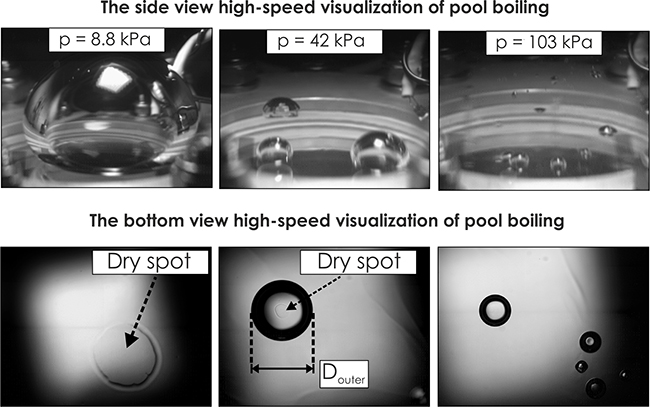
In their approach, water was boiled to saturation at subatmospheric pressure range 8.8 – 103 kPa using a combination of specially designed transparent ITO heater and two techniques: infrared thermography, and high-speed visualization. Specifically, the effects of reduced pressure on the main boiling characteristics, including heat transfer coefficients, dry spots and liquid microlayer evolutions, nucleation site density and the vapor bubbles dynamics, were evaluated.
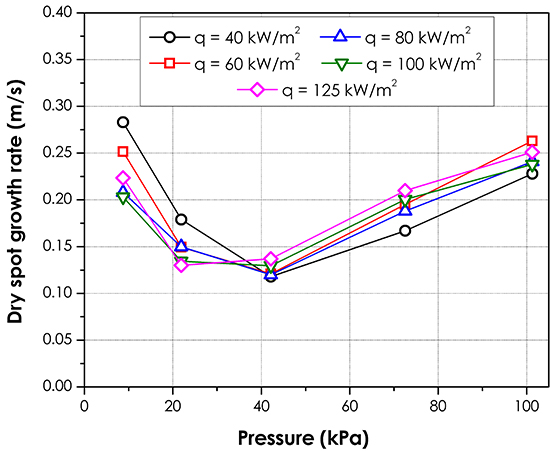
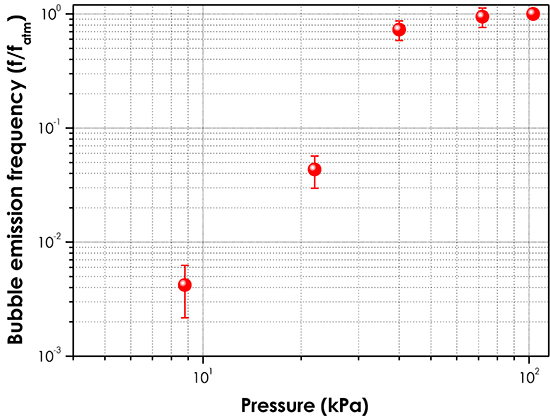
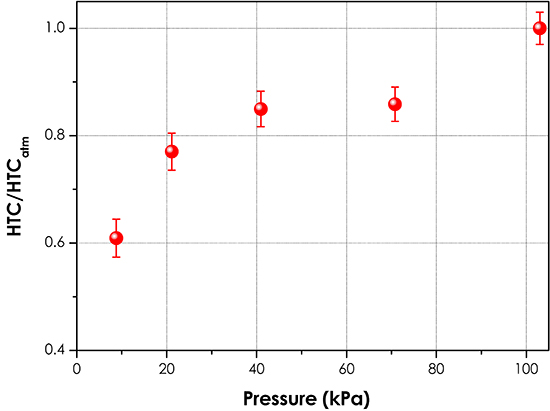
The authors, for the first time, successfully investigated the dry spots evolution under vapor bubbles for water boiling at subatmospheric pressure using bottom side high-speed visualization. The growth rate of the dry spots was further observed to be constant in time with non-monotonic dependence on the pressure. The pressure decrease resulted in an increase in the vapor bubbles growth rate and departure diameter as well as a corresponding decrease in the nucleation site density, bubble emission frequency and heat transfer coefficients. At low subatmospheric pressures, bubble growth could be classified into three stages: inertia-controlled stage, heat-diffusion controlled stage and the stage combining the heat diffusion and inertial effects. Also it was noted that significant increase in the inertial stage duration with a decrease in the pressure is observed. Based on the information obtained, the interconnection between the local characteristics of boiling and the heat transfer rate is determined, and a discussion of the possible reasons for the observed nonmonotonic dependence of the growth rate of dry spots on pressure is presented.
In summary, the study investigated the effect of subatmospheric pressures on the multiscale boiling characteristics using modern experimental techniques. Moreover, the evolution of the dry spots bounded by triple contact lines depending on pressure was investigated for the first time. In a statement to Advances in Engineering, the authors said their study produced important insights on the verification of the existing theories as well as formulating new theoretical approaches for describing multiscale boiling characteristics in wide range of system pressure.



References
Surtaev, A., Serdyukov, V., & Malakhov, I. (2020). Effect of subatmospheric pressures on heat transfer, vapor bubbles and dry spots evolution during water boiling. Experimental Thermal and Fluid Science, 112, 109974.
Go To Experimental Thermal and Fluid Science
Surtaev, A., Serdyukov, V., & Malakhov, I. (2020). Features of boiling heat transfer at various pressures on hydrophilic/hydrophobic surfaces. Journal of Engineering Thermophysics, 29 (4), 1-10. (in press)