Using road milling materials
Currently, road milling materials such as reclaimed asphalt pavement and reclaimed cement-stabilized base-course are being widely used as recycle aggregates to prepare cement stabilized cold recycling mixtures used in the rehabilitation and repair of pavements and highways. This can be attributed to the scarce and high cost of natural aggregates and the need to promote sustainable growth by eliminating the environmental problems associated with the disposal of the traditional aggregates. The above road milling materials can be effectively used with the three main road regeneration techniques: hot recycling of asphalt pavement, cold recycling of asphalt pavement, and cold recycling of base-course. Cement stabilized cold recycling mixtures (CSCRM) have, however, attracted significant attention owing to their low cost and good mechanical properties desirable for road construction. Nevertheless, the best engineering performance of CSCRM is yet to be realized because of the limited study on the effect of recycled aggregate composition on its mechanical properties.
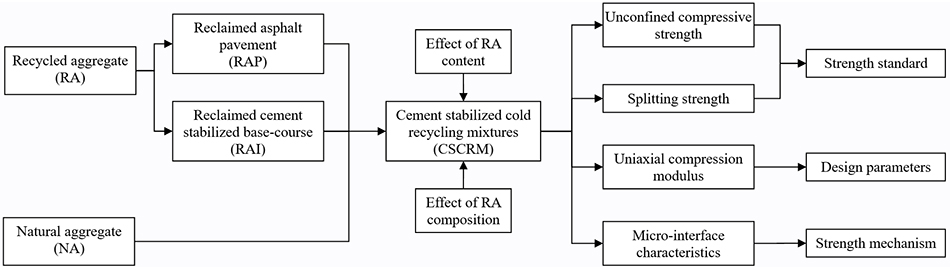
In an effort to fill the existing research gap, Dr. Jiaolong Ren, Miss Siyuan Wang, and Mr. Guangyuan Zang from the Shandong University of Technology conducted a thorough investigation on the effects of recycled aggregate composition on the mechanical properties, and material design of cement stabilized cold recycling mixtures using road milling materials. In their approach, forty-two groups of CSCRM were prepared to analyze the mechanical characteristics with specific attention to the changes in recycled aggregate contents and compositions, curing ages, and the cement contents. Some of the investigated mechanical properties included splitting strength, unconfined comprehensive strength, and uniaxial compression modulus. The strength mechanism was examined via micro-interface characteristics of the CSCRM. Lastly, durability tests were performed to verify the material design and performance of the CSCRM.
Results showed that the recycled aggregate contents and composition and the cement content exhibited significant influence on the mechanical characteristics of cement stabilized cold recycling mixtures. An increase in either recycled aggregate content or reclaimed cement stabilized base-course resulted in an increase in the water content. In contrast, a decrease in either recycled aggregate content or the reclaimed asphalt pavement proportion increased the maximum density and reduced mechanical properties. Unlike uniaxial compression modulus, the unconfined compressive strength was more sensitive to both the recycled aggregate content and reclaimed cement stabilized base-course proportion. However, the splitting strength exhibited nearly linear change.
Furthermore, the effects of recycled aggregate content and recycled aggregate composition were more evident in higher cement content even though the former exhibited significant effects than the latter. Additionally, it was worth noting that the cement content could significantly improve the mechanical properties of the cement stabilized cold recycling mixtures, mainly due to the significant effect of the splitting strength. The recommended material design, which was successfully verified through material design, exhibited improved overall performance.
In summary, the study investigated the effects of recycled aggregate composition on the mechanical properties and material design of cement stabilized cold recycling mixtures used in road construction and rehabilitation. Results showed that recycled aggregate compositions have significant effects on the mechanical characteristics of the material. Moreover, the recommended material design exhibited enhanced performance. Altogether, the study by Dr. Ren and colleagues would aid the design of high-performance cement stabilized cold recycling mixtures for road construction applications.

Reference
Ren, J., Wang, S., & Zang, G. (2020). Effects of recycled aggregate composition on the mechanical characteristics and material design of cement stabilized cold recycling mixtures using road milling materials. Construction and Building Materials, 244, 118329.