Geometric error contribution modeling and sensitivity evaluating for each axis of five-axis machine tools

Five-axis machine tools have significantly contributed to the industrial development, and the continuous technological advancement have seen an increase in the demand for highly accurate and reliable five-axis machine tools. Local errors including thermal errors and geometric errors and position of the axes have been identified as major factors influencing the machine tool accuracy. The accuracy has been improved through modeling and compensation of the geometric errors by eliminating or greatly reducing the integrated volumetric errors to realize tool poses close to the design poses. Software compensation is preferred over hardware compensation since its more economical and easier to implement. However, they are unsuitable for design and manufacturing of machine tools. Thus, better strategies for effective implementation of hardware compensation are highly desirable.

Recently, sensitivity analysis has been used to identify the influences of system parameters on system responses. However, error sensitivity analysis does not take into account the values of error components that change with the motion of the corresponding axis making it difficult to design error components for error compensation. Therefore, it is very important to determine the key axes that greatly affect the machine tool accuracy for effective implementation in hardware compensation.

To this note, Dr. Guoqiang Fu, Hongwei Gong (graduate student) and Professor Hongli Gao from Southwest Jiatong University in collaboration with Professor Jianzhong Fu from Zhejiang University and Dr. Xiaolei Deng from Quzhou University investigated the geometric error contribution of all axes to the accuracy of machine tools by establishing the sensitivity matrix of each axis. First, a product of exponential theory was used to determine the error vector components of the position-independent errors. Secondly, the formula was utilized to establish the error contributions of all the axes by transforming the differential changes between the coordinate frames. Finally, two methods: one using the error sensitivity coefficients and the other employing the weights of the error contributions of the axes were employed to determine the crucial axis affecting the accuracy of the five-axis machine tools. The work is published in the International Journal of Machine Tools and Manufacture.

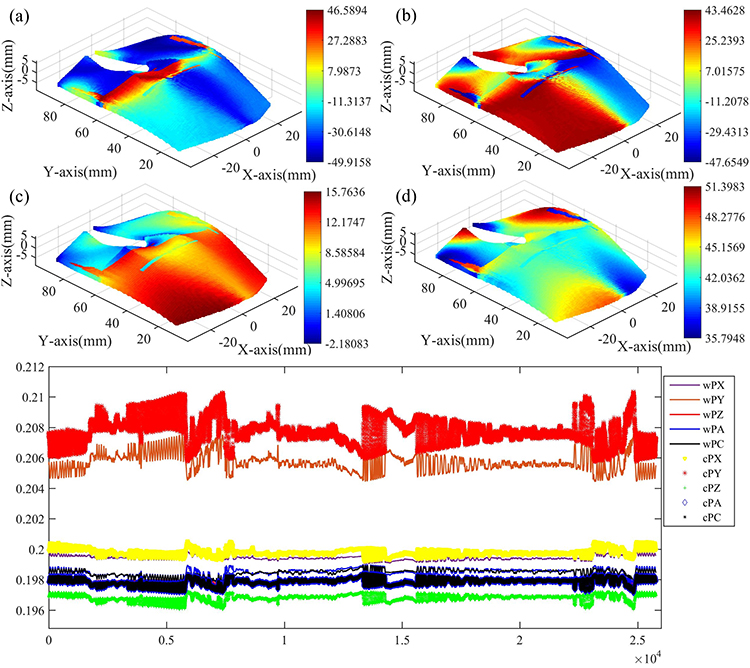
Results showed that it was possible to establish precise error vectors of each axis. The summation of the error contributions of all the axes was regarded as the integrated geometric error of the machine tool. Additionally, the two error sensitivity evaluation methods were used to determine the critical axes, which were thereafter used to analyze the geometric error compensation. As proof of the concept, the effectiveness of the error contribution modeling and error sensitivity evaluation of the axis was validated based on the simulations of the real cutting experiments on the smartCNC500-DRTD five-axis machine tool. Specifically, a simulation based on the hardware compensation, where the local errors of the crucial axes were set to zero, was proposed. The error sensitivity evaluation proved effective.

In a nutshell, a combined advantage of the product of exponential theory and transforming differential changes between the coordinate frames greatly contributed to the calculation of the geometric error contribution and error sensitivity analysis of the machine tool. According to Dr. Guoqiang Fu, the study insights will pave the way for low-cost error compensation for efficient design and manufacture of accurate machine tools.


Guoqiang Fu is currently an associate professor in school of mechanical engineering at Southwest Jiaotong University, Chengdu, P. R. China. He received the bachelor’s degree in mechanical design and manufacture and automation from Chongqing University (2011), and Ph.D. degree in mechanical manufacture and automation from Zhejiang University (2016). He was a visiting scholar in S.M. Wu Manufacturing Research Center at the University of Michigan in 2017-2018.

His research interests include precision measurement of machine tools, error modeling, error identification and compensation of machine tools, CAM/CAD/CNC and precision manufacturing. Dr. Fu has undertaken one project funded by National Natural Science Foundation of China and several provincial/ministerial projects. He has published more than 15 international journal papers. He is also the reviewer of more than 5 international journals.

Hongwei Gong is currently a postgraduate student of Southwest Jiaotong University. He received the B.E. degree in Mechanical Engineering from North University of China. As a graduate student, he published academic papers in SCI published and one EI conference paper as a second author. His research interest is the error modeling of machine tool spindle. He won honorary titles such as the National Graduate Scholarship and the Outstanding Graduate of Southwest Jiaotong University during his stay at the university.

.

Jianzhong Fu is currently a professor in mechanical engineering at Zhejiang University, China. He received his B.E., M.S. and Ph.D. in college of mechanical engineering at Zhejiang University, in July 1990, 1992 and 1996, respectively. He was a visitor scholar in mechanical engineering department of Hong Kong University in 2003. He was awarded the “Ten thousand talents plan” innovation and entrepreneurship talents of the Central Organization Department, leading talents of science and technology innovation and Entrepreneurship of the Ministry of science and technology of the people’s Republic of China and outstanding scientific and technological workers in Zhejiang Province. Currently, Dr. Fu has undertaken one National Support Plan project, four projects funded by National Natural Science Foundation of China, one 863 key project and several enterprise commissioned projects.

His research interests are intelligent manufacturing technology and equipment, including the 3D printing, numerical control and computer-aided design. He has published more than 100 academic papers in SCI published in international and domestic journals, won three provincial and ministerial science and technology progress awards and owned more than 100 national invention patents.

Hongli Gao is currently a professor in School of Mechanical Engineering, Southwest Jiaotong University. He received the Ph.D. degree in Mechanical Manufacturing and Automation from Southwest Jiaotong University, China in 2005. He was a visitor scholar at George Mason University in 2013. Currently, he is the director of the Department of Mechanical and Electrical Measurement and the director of High-Speed Structures and Structural Dynamics Research Center, Southwest Jiaotong University.

Dr. Gao has been conducting research in the field of electrohydraulic system design and reliability. In response to the development needs of CNC machine tools, he first proposed the concept and basic theory of service life of CNC machine tools, established a systematic service life prediction theory and evaluation system and laid the theoretical foundation for adaptive machining and intelligent health protection of CNC machine tools.

His research interests are design reliability of complex electromechanical systems, intelligent state monitoring and fault diagnosis technology, intelligent electromechanical-hydraulic integration equipment, smart robot and high-speed structural design and dynamic analysis. Dr. Gao published over 100 academic papers and holds more than 50 patents. He has undertaken more than 30 projects and won two First Prizes for Teaching Achievements in Sichuan Province.

Xiaolei Deng is currently an associate professor in mechanical engineering at Quzhou University, China. He received his PhD at Zhejiang University, China (2014). He studied at University of Missouri (America) as a visiting scholar in 2013-2014. Dr. Deng has undertaken 1 project funded by National Natural Science Foundation of China and several provincial projects. He has published about 80 peer-viewed journal papers and most of them were published in the respected journals. He serves as a peer reviewer for more than 10 Journals. He is an active senior member of Chinese Mechanical Engineering Society.

His research interests include digital design and manufacturing technology, thermal design technology of Machine tool and CNC equipment and automation technology.

Reference

Fu, G., Gong, H., Fu, J., Gao, H., & Deng, X. (2019). Geometric error contribution modeling and sensitivity evaluating for each axis of five-axis machine tools based on POE theory and transforming differential changes between coordinate frames. International Journal of Machine Tools and Manufacture, 147, 103455.

Go To International Journal of Machine Tools and Manufacture

Share:

Facebook
Twitter
LinkedIn