In biology, haemorheology is defined as the study of flow properties of blood and its elements of plasma and cells. The viscosity of blood is a basic biological parameter affecting the blood flow both in large arteries and in microcirculations. The human blood is a dense suspension consisting of 55 % fluid (plasma) and 45 % blood cells, with over 98 % of the cells being red blood cells (RBCs). This makes the hydrodynamic interactions of individual RBCs of fundamental importance for haemorheology. As such, numerous studies on haemorheology from the single-cell level to macroscale blood flow have been conducted over the years. Unfortunately, much is still unknown; particularly regarding how the single-cell behavior relates to the behavior in suspensions and then rheology. Worse off, it is still unclear on how various motions of individual RBCs affect the bulk suspension rheology.
To address this, Osaka University scientists: Dr. Naoki Takeishi and Dr. Shigeo Wada, in collaboration with Dr. Marco E. Rosti and Dr. Luca Brandt at the Linné Flow Centre and SeRC (Swedish e-Science Research Centre), KTH Mechanics, Stockholm, Sweden, and Dr. Yohsuke Imai at the Kobe University conducted a numerical analysis of the rheology of a suspension of RBCs in a wall-bounded shear flow. Their aim was to clarify the behavior of individual RBCs from dilute to dense suspensions, and to elucidate the relationship between behaviors of individual RBCs and haemorheology. Their work is currently published in Journal of Fluid Mechanics.
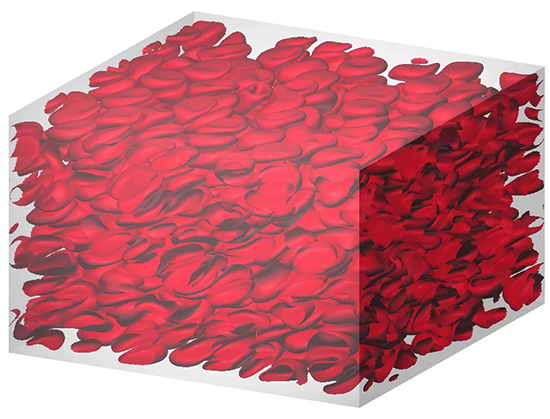
Technically, for them to obtain a rheological description of RBC suspensions, they had to investigate the effect of a wide range of viscosity ratios λ = 0.1–10, non-dimensional shear rates capillary number, (Ca) and volume fractions φ. The researchers subsequently performed numerical simulations to study the behavior of RBCs subjected to various Ca in wall-bounded shear flow from dilute suspensions to dense suspensions. In their approach, RBCs were modelled as biconcave capsule, whose membrane follows the Skalak constitutive law. Owing to the nature of their problem, they resorted to employing graphics processing unit (GPU) computing, using the lattice-Boltzmann method (LBM) for the inner and outer fluid, and the finite-element method (FEM) to follow the deformation of the RBC membrane.
The authors observed that a single RBC subjected to low Ca was disposed to orient to the shear plane and exhibited rolling motion as a stable mode associated with higher intrinsic viscosity than tumbling motion. In addition, they noted that as Ca increased, the mode shifted from rolling to swinging motion, while on the other hand the intrinsic viscosity decreased. In fact, the hydrodynamic interactions were seen to allow RBCs to exhibit the tumbling or swinging motions resulting in a decrease of the intrinsic viscosity for dilute and semi-dilute suspensions. The authors also tackle the challenge of constructing a viscosity law as a function of volume fraction of RBCs. Einstein (1911) proposed the viscosity law for a dilute suspension of rigid particles using only first order term of φ. However, a polynomial law for dense suspension of non-spherical deformable particles such as RBCs is still missing due to the complexity of the phenomenon. The authors showed that conventional ways of modelling the relative viscosity as a polynomial function of φ cannot be simply applied in suspensions of RBCs at low volume fractions because of mode change described above. The relative viscosity for high volume fractions, however, can be well described as a function of an effective volume fraction, defined by the volume of spheres of radius equal to the semi-middle axis of a deformed RBC. The authors found that the relative viscosity successfully collapses on a single nonlinear curve independently of λ except for the case with Ca ≥ 0.4 (which is basically higher shear rate than that in human arterioles), where the fit works only in the case of low/moderate volume fraction, and fails in the case of a fully dense suspension. Constructing a model that is able to cover a large deformation of RBCs is next challenge.
In summary, the study numerically investigated the rheology of a suspension of RBCs in a wall-bounded shear flow for a wide range of volume fractions, viscosity ratios and capillary numbers assuming the Stokes flow regime. The researchers modeled and solved the problem through GPU computing while applying both LBM and FEM. In an interview with Advances in Engineering, Dr. Naoki Takeishi highlighted that it was their hopes that the numerical results they presented would stimulate further numerical and experimental study of haemorheology, aiming to gain insight not only into suspension rheology, but also into the precise diagnosis of patients with haematologic disorders.
Name: Naoki Takeishi
Degree: Ph. D. in Biomedical Engineering (March 2016, Tohoku University, Japan)
Position: Assistant Professor
Affiliation: Department of Mechanical Science and Bioengineering
Email: [email protected]
Professional Experiences:
Apr. 2014-Mar. 2016
Research Fellow (DC2) of Japan Society for the Promotion of Science (JSPS) at Graduate School of Biomedical Engineering, Tohoku University, Japan (Supervisor: Prof. Takuji Ishikawa).
Apr. 2014-Mar. 2015
Visiting Student at Massachusetts Institute of Technology, Massachusetts (MIT), USA (Supervisor: Prof. Roger D. Kamm).
Apr. 2016-Mar. 2017
Research Fellow (PD) of JSPS at Institute of Frontier Life and Medical Science, Kyoto University, Japan (Supervisor: Prof. Taiji Adachi).
Apr. 2017-present
Assistant Professor of Graduate School of Engineering Science, Osaka University, Japan.
Aug. 2017-Nov. 2017
Visiting Researcher at Royal Institute of Technology (KTH), Stockholm, Sweden (Supervisor: Prof. Luca Brandt).
Education:
Mar. 2011 B. S. in Mechanical Engineering, Shizuoka University, Japan.
Mar. 2013 M. S. in Biomedical Engineering, Tohoku University, Japan.
Apr. 2014-Mar. 2015 Visiting Student, Massachusetts Institute of Technology, Massachusetts, USA.
Mar. 2016 Ph. D. in Biomedical Engineering, Tohoku University, Japan.
Award:
Yamaguchi Medal at 8th World Congress of Biomechanics, Dublin, Ireland (2018).
Japan Society of Mechanical Engineering Young Engineers Award (2017)
Inoue Research Award for Young Scientists (2016)
Presidential Prize for Excellence at Tohoku University (2016)
Research area:
Computational fluid mechanics, computational biomechanics, microcirculation, suspension rheology, cell/membrane mechanics, cancer metastasis, cerebral fluid.
Reference
Naoki Takeishi, Marco E. Rosti, Yohsuke Imai, Shigeo Wada, Luca Brandt. Haemorheology in dilute, semi-dilute and dense suspensions of red blood cells. Journal of Fluid Mechanics (2019), volume 872, page 818–848.