Numerical modeling and simulation represent the current paradigm in science that aims at high fidelity and cost effectiveness. Consequently, model reduction techniques have been developed to meet the requirements, while at the same time to minimize the size and intricacy of the model. Previously, a novel parametric reduced-order model (PROM) technique for linear systems was developed based on the so-called dynamic eigen decomposition (DED) and modally equivalent perturbed system (MEPS). The main advantage of the scheme is that it isolates all the parameter changes into the right-hand side forcing term, thereby allowing the perturbed system to be analyzed through the ordinary differential equation with constant coefficients and varying forcing terms. It was shown that when the parameter variation is limited to a finite dimension, the scheme yields an exceptionally accurate reduced-order model for a wide range of parameter values. However, although the theory of the MEPS is valid for all ranges of the variations, in certain situations its frequency snapshots may lack the spatial richness necessary for capturing the full spectrum of the solution subspace.
To address this issue and seek for a remedy, Dr. Taehyoun (John) Kim at the Department of Mechanical Engineering from National University of Singapore (currently at Pegase Avtech in Washington) critically reviewed the original method with the aim of improving it and making it numerically robust for parameter variations that propagate in a larger dimensional domain and possibly the entire domain. The author effected the aforementioned changes by expanding the original first-order MEPS to a higher-order MEPS (HOMEPS) adding the extra higher-order terms in the formulation. His work is currently published in the International Journal for Numerical Methods in Engineering.
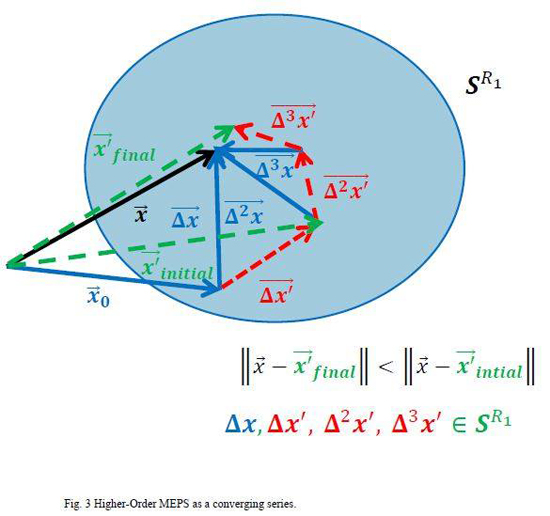
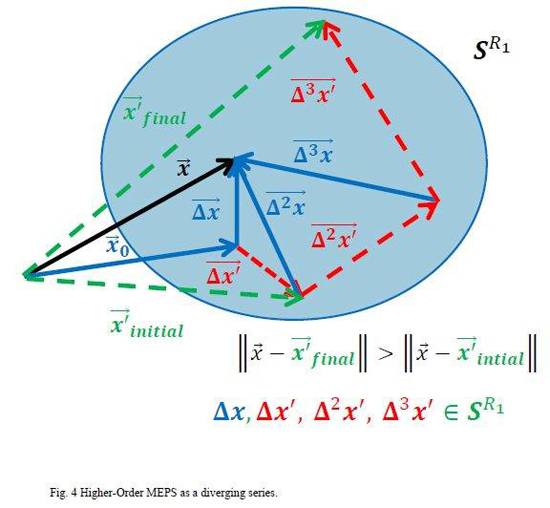
Interestingly, the author showed that when expressed in powers of incremental matrices, the new formula becomes identical to a truncated Neumann series, which in turn can be replaced by a Taylor series of the same order without affecting the modal space that it represents. It is well known that the Neumann series converges or diverges depending on the norm of the incremental matrix. On the other hand, the HOMEPS always converges in that it improves the basis vectors as more of the higher-order terms are added. The attached figures illustrate graphically the fundamental difference in the two matrix approximations. Whereas in the first plot, the HOMEPS converges in both magnitude and direction, in the second, it converges in direction but diverges in magnitude.
In summary, the study extended the previously presented MEPS formula to account for parameter variations in a larger domain and the global domain by deriving and adding the higher-order terms. The improved PROM scheme was demonstrated using a computational fluid dynamics model of unsteady air flow around a 2D airfoil with Mach variation at subsonic speeds. Predictably, it was shown that the results of the higher-order PROM match very well those of the full-order models for a wide range of Mach numbers improving significantly over the previous PROM.

Reference
T. Kim. Higher-order modal transformation for reduced-order modeling of linear systems undergoing global parametric variations. International Journal for Numerical Methods in Engineering 2018;volume 115: page 1477–1498.
Go To International Journal for Numerical Methods in Engineering