Wang G, Leng Y, Dou H, Wang L, Li W, Wang X, Sun K, Shen L, Yuan X, Li J, Sun K, Han J, Xiao H, Li Y.
ACS Nano. 2013 Jan 22;7(1):471-81.
The State Key Lab of Metal Matrix Composites, School of Materials Science and Engineering, Shanghai Jiao Tong University, Shanghai 200240, People’s Republic of China.
Abstract
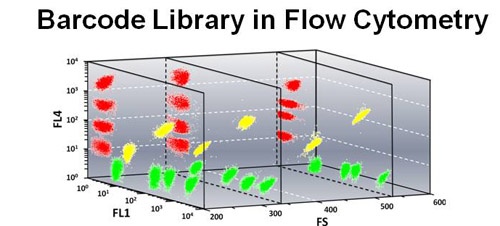
Both disease diagnosis and therapeutic treatments require real-time information from assays capable of identifying multiple targets. Among variousmultiplexed biochips, multiplexed suspension assays of quantum dot (QD)-encoded microspheres are highly advantageous. This arises from the excellent fluorescent properties of the QDs incorporated into these microspheres, thus allowing them to serve as “QD barcodes”. QD barcodes can be prepared through various approaches. However, the formulation of improved synthetic techniques that may allow more efficient preparation of QDbarcodes with better encoding accuracy still remains a challenge. In this report, we describe a combined membrane emulsification-solvent evaporation (MESE) approach for the efficient preparation of QD barcodes. By combining the advantages of the MESE approach in controlling the barcode sizes with accurate encoding, a three-dimensional barcode library that integrates the signals of the forward scattering, fluorescence 1, and fluorescence 4 channels was established via flow cytometry. The five indexes of hepatitis B viruses were chosen as diagnostic targets to examine the feasibility of the QD barcodes in high-throughput diagnosis. On the basis of showing that singleplex detection is feasible, we demonstrate the ability of these QDbarcodes to simultaneously and selectively detect a multitude of diverse biomolecular targets.