
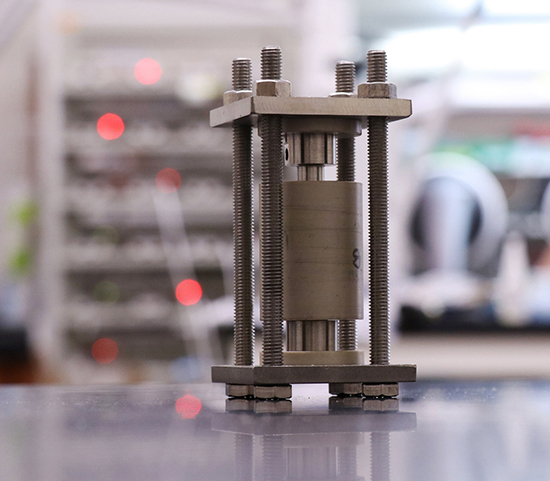
The Georgia Tech research team led by Matthew McDowell, an assistant professor in the George W. Woodruff School of Mechanical Engineering and the School of Materials Science and Engineering built special test cells about two millimeters wide which were designed to be studied at the Advanced Photon Source, a synchrotron facility at Argonne National Laboratory, a U.S. Department of Energy Office of Science facility located near Chicago. The authors studied the changes in battery structure during a five-day period of intensive experiments. The instrument takes images from different directions, and you reconstruct them using computer algorithms to provide 3-D images of the batteries over time.
Using X-ray tomography, a research team has observed the internal evolution of the materials inside solid-state lithium batteries as they were charged and discharged. Detailed three-dimensional information from the research could help improve the reliability and performance of the batteries, which use solid materials to replace the flammable liquid electrolytes in existing lithium-ion batteries.
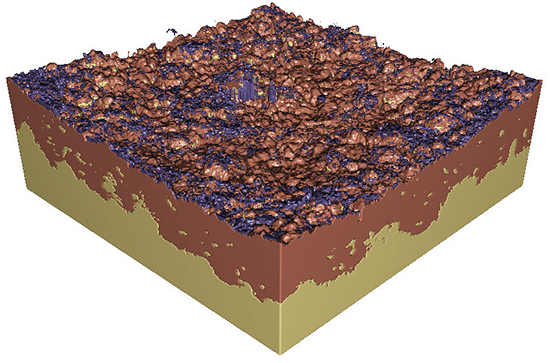
The operando synchrotron X-ray computed microtomography imaging revealed how the dynamic changes of electrode materials at lithium/solid-electrolyte interfaces determine the behavior of solid-state batteries. The researchers found that battery operation caused voids to form at the interface, which created a loss of contact that was the primary cause of failure in the cells. The findings provides fundamental understanding of what is happening inside the battery, and that information should be important for guiding engineering efforts that will push these batteries closer to commercial reality in the next several years. The research work is now published in journal Nature Materials.
Because of limitations in the testing, the researchers were only able to observe the structure of the batteries through a single cycle. In future work, the research team would like to see what happens over additional cycles, and whether the structure somehow adapts to the creation and filling of voids. They believe the results would likely apply to other electrolyte formulations, and that the characterization technique could be used to obtain information about other battery processes. Battery packs for electric vehicles must withstand at least a thousand cycles during a projected 150,000-mile lifetime. While solid-state batteries with lithium metal electrodes can offer more energy for a given size battery, that advantage won’t overcome existing technology unless they can provide comparable lifetimes. The study should help advance this technology toward broader commercial applications

Reference
John A. Lewis, Francisco Javier Quintero Cortes, Yuhgene Liu, John C. Miers, Ankit Verma, Bairav S. Vishnugopi, Jared Tippens, Dhruv Prakash, Thomas S. Marchese, Sang Yun Han, Chanhee Lee, Pralav P. Shetty, Hyun-Wook Lee, Pavel Shevchenko, Francesco De Carlo, Christopher Saldana, Partha P. Mukherjee & Matthew T. McDowell. Linking void and interphase evolution to electrochemistry in solid-state batteries using operando X-ray tomography. Nature Materials (2021)