Unlocking the performance of a unique class of materials
Shape memory alloys (SMAs) are characterized by remarkable thermoplastic phase transformation properties, making them appropriate for various applications such as sensors and actuators. Among the available SMAs, Fe-based, Cu-based and, especially, binary NiTi as well as NiTi-based alloys have been extensively studied and are the most used. Notably, besides desirable properties, the choice of future generation SMAs will also be largely influenced by their cost and ease of manufacturing in various conditions. Owing to the inherent disadvantages of NiTi-based and Fe-based alloys, Cu-based SMAs have continued to attract significant research attention due to their perceived ease of manufacturing, cost-effectiveness and promising shape memory behavior.
Since its invention, additive manufacturing (AM) has grown in prominence and popularity to become one of the most preferred techniques for producing alloys and high-performance parts. Laser powder bed fusion (LPBF), also called selective laser melting (SLM), is the most used AM process to fabricate SMAs nowadays. It allows a precise control of the process parameters and, thus, provides opportunities for tailoring the microstructure and corresponding alloy properties. Additionally, its high intrinsic cooling rates prevent the precipitation of brittle phases, which is a major advantage for direct manufacturing of Cu-based SMAs. Nevertheless, despite the extensive study of Cu-based alloys such as Cu-Zn-Al, Cu-Al-Ni-Ti and Cu-Al-Ni-Mn-(Zr), there are no attempts to manufacture Cu-Al-Mn materials via LPBF despite its practical implications. Cu-Al-Mn SMAs exhibit excellent ductility and superior superelasticity for an adjustable temperature range. However, to achieve an enhanced superelasticity, it requires a microstructure that is less susceptible to cracking as often seen for ordinary polycrystalline alloys (equiaxial coarse-grained). Interestingly, research has shown that this challenge can be addressed through LPBF, which is capable of producing specimens with columnar grains in order to suppress local stress concentration and plastic deformation.
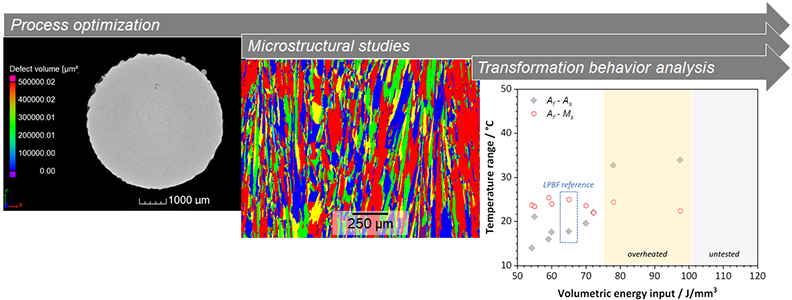
On this account, Ass. Prof. Nazim Babacan (former Alexander von Humboldt fellow at Leibniz IFW Dresden) from Sivas University of Science and Technology (Turkey) and Dr. Tobias Gustmann from Leibniz IFW Dresden (Germany) investigated the processability of a superelastic Cu-Al-Mn SMAs using laser powder bed fusion. Specifically, the authors used a gas-atomized Cu71.6Al17Mn11.4 powder with particle sizes less than 75 microns. The effect of the process parameters on the relative density and transformation temperatures were investigated systematically. For a comprehensive understanding, the microstructure and mechanical properties of selected additively manufactured samples were compared to specimens fabricated by conventional induction casting. The work is published in the journal Materials and Design.
The research team reported the successful fabrication of dense and crack-free Cu-Al-Mn shape memory samples across a wide range of applied LPBF parameters. The manufacturing process allowed for the tailoring of the grain size and microstructure of the investigated specimens. Furthermore, higher transformation temperatures were achieved by increasing the volumetric energy input. Unlike other SMAs, viz. Fe- and NiTi-based materials, increasing the energy input did not alter the chemical composition of the alloy. This is a very noteworthy outcome as it shows how flexible Cu-SMAs can be fabricated via LPBF. In addition, the precipitation of the α phase associated with the inhibition of the martensitic transformation (cast counterparts) was not observed in the fully austenitic LPBF samples. The additively manufactured samples achieved a maximum recoverable strain of 2.86% for an applied compressive strain of 5%. In general, an enhanced shape recovery and, for instance, a higher yield strength was observed in contrast to the cast specimens. These findings were attributed to the formation of a relative fine microstructure and a columnar grain morphology along the building direction (testing direction).
In summary, the authors are the first to demonstrate the manufacturing of a superelastic Cu-Al-Mn SMA by laser powder bed fusion. Compared to conventional fabrication techniques, it directly produced specimens with remarkable properties desirable for application-orientated approaches and the use of alternative shape memory materials. The authors also noted that LPBF is further promising for producing individually designed Cu-Al-Mn shape memory parts. In a statement to Advances in Engineering, Ass. Prof. Nazim Babacan and Dr. Tobias Gustmann stated that their studies will continue to overcome last existing constraints. They also hope that other scientists around the world will consider their work for addressing future research on the basis of an implementation of Cu-based SMAs.


Reference
Babacan, N., Pauly, S., & Gustmann, T. (2021). Laser powder bed fusion of a superelastic Cu-Al-Mn shape memory alloy. Materials & Design, 203, 109625.