From the mid-twentieth century, theoretical based linear interaction analysis has been used to solve the problem of interaction between disturbances and shock waves. With continued technological advancement, the laminar-turbulent transition has proved to be a crucial aspect of both scientific research and engineering applications. This has initiated the development of more advanced techniques for analysis of shock-turbulence interactions considering the complex nature of the transition. Direct numerical simulation has been recently used in various analysis of shock-turbulence interactions. Despite the contribution of these two methods, some theoretical problems have remained unsolved to date. This includes the effect of not stimulating acoustic waves behind the shock waves and the interaction between the existing critical angles. Additionally, shock waves over supersonic/hypersonic bodies can be described as either bow or oblique shock waves. The latter is much simpler and its disturbances through the shock wave can be treated as a one-dimensional problem.
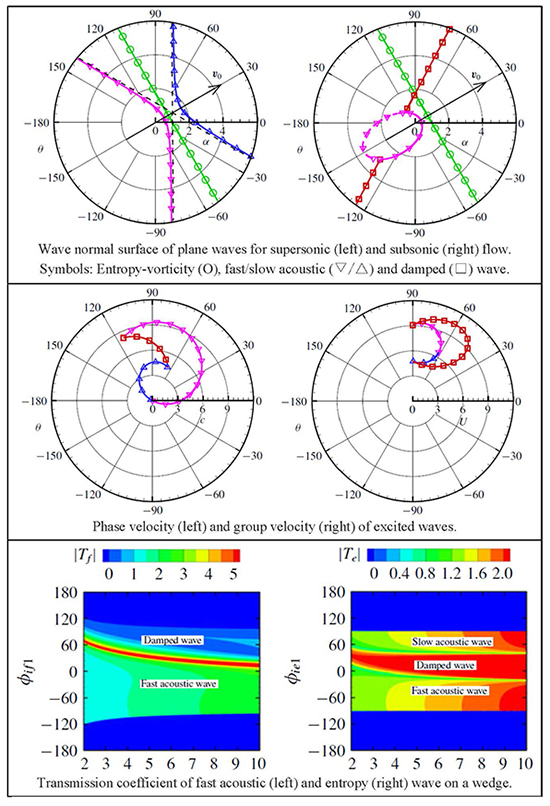
To address the existing theoretical problems, Dr. Zhangfeng Huang and Dr. Huilin Wang from the Tianjin University investigated the linear interaction of two-dimensional free-stream disturbances with an oblique shock wave. In particular, they presented a damped wave concept as a type of plane wave in uniform and homogeneous flow field and especially in cases where no acoustic waves were generated. Based on this, the authors constructed the relationships (dispersion and amplitude) between the incident plane wave and stimulated waves both analytically, systematically and comprehensively. Their work perfected the linear interaction theory of disturbances with an oblique shock wave and is published in the Journal of Fluid Mechanics.
The existence of the critical angles and the angle limitation of an incident plane wave were clarified. Incident plane waves exhibited limited wave angles than ordinary plane waves. Ideally, an incident plane wave before the shock wave should propagate downstream while the one behind the shock wave should propagate upstream towards the shock wave. Consequently, an incident wave cannot excite both the slow and fast acoustic waves at the same time due to their opposing excitation conditions. Furthermore, the damped wave was demonstrated to be a complex solution to the acoustic dispersion relationship under certain conditions. For instance, it acted as a connecting bridge for the slow and fast acoustic wave for zero x-component group velocity. However, no angle limitations on the excitation of entropy and vorticity waves were observed.
Based on theoretical and direct numerical simulation results, the concept was verified and its feasibility in engineering applications i.e. wedge model was evaluated. An increase in the free-stream Mach number resulted in a rapid decrease in the shock angle. This was attributed to the fact that both the amplitudes before shock wave and after the post-shock fluctuations exhibited the same order. On the other hand, the free-stream Mach number greatly influenced the transmission coefficients of the incident fast acoustic and entropy waves and showed insignificant influence on the incident vorticity waves. Overall, good agreement was found in all comparisons indicating that the presented approach is an improvement of the linear interaction analysis. In a statement to Advances in Engineering, Dr. Zhangfeng Huang, the lead author explained that their study can be extended to investigate the free-stream disturbances of complex bow shock waves.

Reference
Huang, Z., & Wang, H. (2019). Linear interaction of two-dimensional free-stream disturbances with an oblique shock wave. Journal of Fluid Mechanics, 873, 1179-1205.