Many sensors, such as SMO gas sensors, require heating to relatively high temperatures to activate their primary sensing functionality. Usually, a microheater is integrated into the device underneath the sensing film to achieve the required sensor heating. Among the available microheater materials, platinum is commonly used owing to its high stability, high melting point, linear temperature response, and resistance to oxidation at a wide range of operating temperatures. Additionally, platinum is suitable for cost-effective fabrication as it ensures proper integration of the sensor components with digital and analog electronics. However, the potential of thermo-migration (TM) and electro-migration (EM) induced failure due to accelerated stress accumulation has been experimentally shown in thin platinum films. Therefore, new platinum microheater designs that can prevent such failure are highly desirable.
Ensuring the mechanical stability of the micro-electron-mechanical systems (MEMS) structures is one of the major challenges in designing gas sensor microheaters. The membrane structures are highly susceptible to thermal stresses induced during fabrication or operation. Thus, it is imperative to model the TM and EM induced effects in microheaters by analyzing the stress accumulation in the sensor microheater as well as in the membrane structures making up the sensors, especially at elevated temperature involved in their fabrication and operation. Nevertheless, experimental quantification and understanding of these effects are often difficult because many other factors influence the materials stacks at elevated temperatures, including thermal expansion, membrane deflection and relaxation, atom diffusion from adhesion layer, and cracking and delamination. Thus, the effects of these factors must also be considered in the design of platinum microheaters.
A new study by Professor Lado Filipovic from Technische Universität Wien was conducted to examine the thermo-migration and electro-migration in two novel platinum microheater designs. The first design focused on reducing the operating power while providing temperature uniformity to ensure a uniform sensing area and the second one aimed at achieving microheater array applications by using a single device to provide multiple temperatures simultaneously. Also, the two designs contained platinum microheater and titanium-tungsten dielectric on a SiO2/SiN/SiO2 membrane stack. The main aim was to understand the effects of TM and EM on the reliability and functionality of the proposed microheaters and whether increasing temperature uniformity could improve the sensor’s lifetimes. The work is currently published in the journal, Microelectronics Reliability.
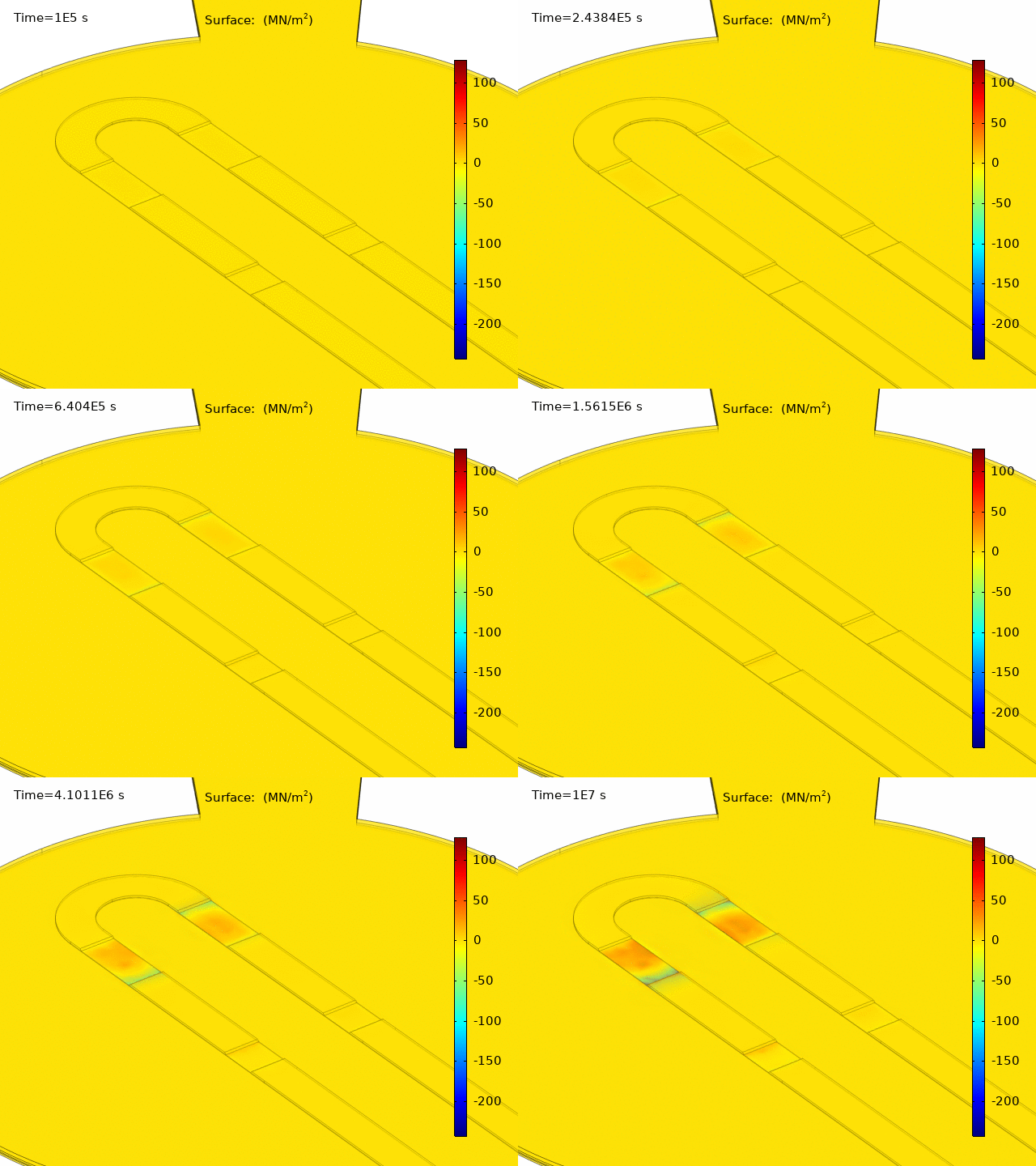
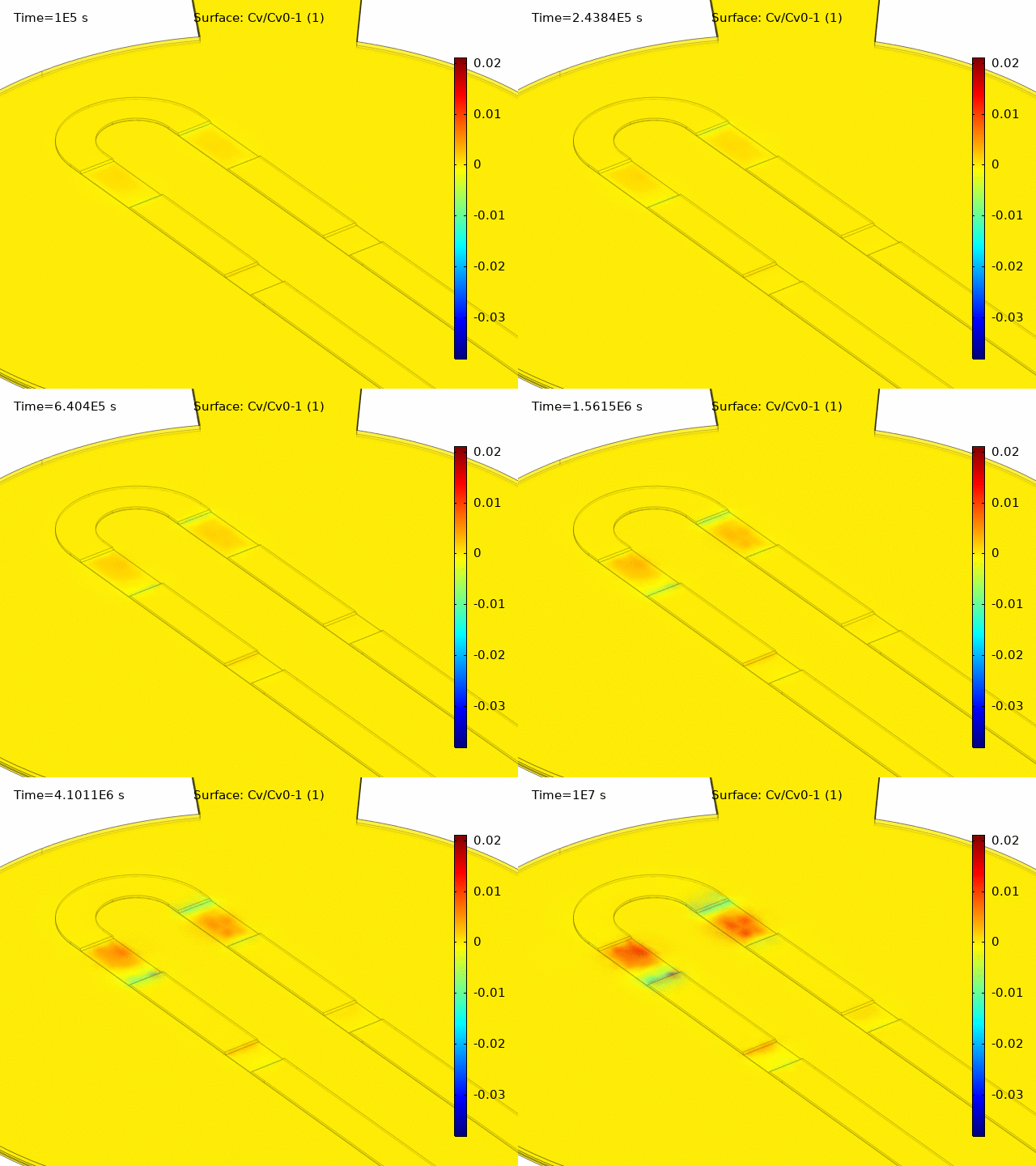
Professor Lado Filipovic showed that the TM force was significantly higher than the EM force, resulting in high atom accumulation and increased compressive stresses in regions characterized with higher temperature gradients. This signified that TM could be a more critical design considering than EM. Consequently, the microheater array of the second design exhibited a higher temperature gradient and higher electric field than the uniform temperature of the first design, suggesting that the second design was more susceptible to failure due to TM- and EM-induced stresses. Furthermore, it was observed that the mean-time-to-failure (MTTF) of the platinum microheaters followed an Arrhenius expression with remarkable activation energy that was not affected by the heater’s geometry.
In summary, the study by Professor Lado Filipovic examined the impacts of EM and TM forces on the reliability and lifetime of newly designed platinum microheaters intended for potential application in low-power SMO sensors. The significant impact of the high thermal gradient on the stress built-up and vacancy transport in platinum microheaters was confirmed. Based on the calculated MTTF, the proposed design exhibited high resistance to vacancy migration-induced failure under typical operating conditions. Still, they could achieve increased stress operating at unrealistically increased temperature and power conditions. In a statement to Advances in Engineering, Professor Lado Filipovic stated that One of the major drawbacks of chemiresistive sensors is their lack of selectivity and specificity. Observing a simple change in resistivity does not provide enough information to know exactly which molecule has induced this change. To introduce selectivity to semiconductor metal oxide gas sensors, researchers have started looking into using microheater arrays to simultaneously provide multiple temperatures in a small space, combined with a sensor array. The stark changes in temperature, however, can induce high thermal gradients, thereby inducing thermo-migration in metallic microheaters. In our study, we look at such a design when using a platinum microheater and we look at how the high thermal gradients can impact the reliability and lifetime of these highly important devices.
Reference
Filipovic, L. (2021). Theoretical examination of thermo-migration in novel platinum microheaters. Microelectronics Reliability, 123, 114219.