
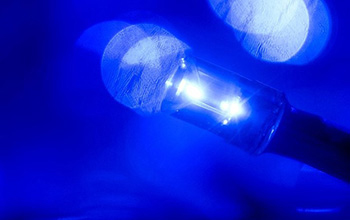
LED lightbulbs are popular because of their low energy consumption, long lifespan and ability to turn on and off quickly. Inside the bulb, an LED chip converts electrical current into high-energy light, including invisible ultraviolet, violet or blue wavelengths. A cap that is placed on the chip contains multiple phosphors solid luminescent compounds that convert high-energy light into lower-energy visible wavelengths.
To be more energy efficient, many people have replaced their incandescent lights with LED bulbs. However, those currently on the market emit a lot of blue light, which has been linked to eye troubles and sleep disturbances.
Shruti Hariyani and Professor Jakoah Brgoch from the Department of Chemistry, University of Houston developed a prototype LED that reduces instead of masks the blue component, while making colors appear just as they do in natural sunlight. The research work is published in the research Journal, ACS Applied Materials & Interfaces.
Each phosphor emits a different color, and these colors combine to produce a broad-spectrum white light. Commercial LED bulbs use blue LEDs and yellow-emitting phosphors, which appear as a cold, bright white light similar to daylight. Continual exposure to these blue-tinted lights has been linked to cataract formation and turning them on in the evening can disrupt the production of sleep-inducing hormones, such as melatonin, triggering insomnia and fatigue.
To create a warmer white LED bulb for nighttime use, previous researchers added red-emitting phosphors, but that only masked the blue hue without getting rid of it. So, Jakoah Brgoch and Shruti Hariyani at the University of Houston wanted to develop a phosphor that, when used in a violet LED device, would result in a warm white light while avoiding the problematic wavelength range.
As a proof of concept, the researchers identified and synthesized a new luminescent crystalline phosphor containing europium. In thermal stability tests, the phosphor’s emission color was consistent between room temperature and the higher operating temperature, 301 degrees Fahrenheit, of commercial LED-based lighting.
In long-term moisture experiments, the compound showed no change in the color or intensity of light produced. To see how the material might work in a lightbulb, the researchers fabricated a prototype device with a violet-light LED covered by a silicone cap containing their luminescent blue compound blended with red-emitting and green-emitting phosphors. It produced the desired bright warm white light while minimizing the intensity across blue wavelengths, unlike commercial LED lightbulbs.
The prototype’s optical properties revealed the color of objects almost as well as natural sunlight, fulfilling the needs of indoor lighting, the researchers say, though they add that more work needs to be done before it is ready for everyday use.
In summary, the authors prepared Eu2+-substituted Na2MgPO4F through a single-step solid-state reaction. Optical characterization indicates that Na2MgPO4F:Eu2+ can be efficiently excited by a violet LED to generate a bright blue emission with a full width at half-maximum of 79 nm (3782 cm–1) and room-temperature PLQY of 71.8(9)% upon 400 nm excitation. Temperature-dependent luminescent measurements reveal trap states that delay quenching until 580 K, making the emission thermally robust. The stability of Na2MgPO4F:Eu2+ with respect to moisture and oxidation was analyzed, where the phosphor showed negligible changes after prolonged exposure to water but a 40% loss in PLQY after sitting at 300 °C for 48 days. Finally, Na2MgPO4F:Eu2+ was evaluated for human-centric lighting by fabricating a prototype device driven by a 405 nm LED. The device produced a superior warm white light (CCT = 2710 K) compared to the purchased Soft White Sylvania LED light bulb. Indeed, an exceptional color rendering index (Ra = 93) was achieved while drastically decreasing the amount of blue emission in the white light spectrum. The exceptional optical properties of the Na2MgPO4F:Eu2+ phosphor allow for the production of warm human-centric lighting, effectively transforming the future of LED-based lighting.

Reference
Shruti Hariyani and Jakoah Brgoch. Advancing Human-Centric LED Lighting Using Na2MgPO4F:Eu2+. ACS Appl. Mater. Interfaces 2021, 13, 14,