Rising carbon emissions in the building and construction sector emphasize the urgent need for strategies to aggressively reduce energy demand in the built environment, and implement material strategies that reduce carbon emissions. To date, numerous actions such as using recycled materials have been proposed to reduce the consumption of concrete and cement in the construction industry to limit its environmental impact. While most of these actions are effective in many ways, the growing need for more structurally efficient buildings consuming fewer materials is crucial and cannot be overlooked. However, producing structurally optimized building elements using conventional methods is quite challenging owing to the high costs and formwork waste involved in producing irregular shapes. To this end, digital fabrication technologies, particularly concrete extrusion 3D printing (3DCP), have been proposed as a promising alternative for efficiently fabricating optimized structures consuming fewer materials.
3DCP printing technology is currently under research and development worldwide because it offers numerous possibilities and can contribute to the sustainability of the construction industry. Despite the significant research efforts, reinforcement strategies compatible with 3DCP technology remain largely underexplored. Consequently, 3DCP does not comply with the existing structural integrity requirements, limiting its practical applications. Notably, the few structures built using 3DCP have low demands due to their low load-bearing capacity. Thus, 3DCP must address a wider range of structural components to expand their usage in the construction industry. This can only be achieved by developing effective reinforcement strategies suitable for 3DCP technology. While many reinforcement strategies specifically developed for 3DCP, like the addition of reinforcing cable during printing, have produced promising mechanical performance, their applicability on a structurally relevant scale is limited.
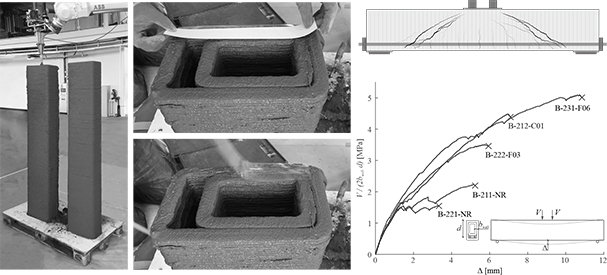
Herein, a team of researchers from ETH Zurich: Lukas Gebhard, Dr. Jaime Mata-Falcón, Ana Anton, Professor Benjamin Dillenburger and Professor Walter Kaufmann, investigated the structural behavior of concrete beams fabricated by 3DCP technology with various reinforcement schemes. The in depth experimental investigation consisted of nine four-point bending tests on 3DCP beams with longitudinal and interlayer shear reinforcement. Two strategies for the longitudinal reinforcement were studied: one set of beams was prepared with unbonded post-tensioning and the other used bonded passive reinforcing bars. In contrast, the interlayer shear reinforcement involved adding steel cable during printing or adding and aligning steel fibers between concrete layers. Digital image correlation was used to track the crack patterns and their related kinematics. Their work is currently published in the research journal Engineering Structures.
The authors found the printing layers had limited influence on the crack patterns for all the tests. Thus, the printing setup did not significantly reduce the strength of the concrete between printed layers. Due to the effects of concrete crushing during bending and deformation localization in the bending cracks, the post-tensioned beams failed in a brittle fashion. On the other hand, multiple bending and shear cracks were observed in the beams with bonded longitudinal reinforcement. Load transfer estimations based on the crack kinematics of the critical crack showed that most of the applied shear force was carried by the interlayer reinforcement. Furthermore, the cable reinforcement exhibited higher efficiency at failure than fiber reinforcement due to its higher tensile strength and continuity.
In a nutshell, the Swiss research team investigated the structural behaviors, crack patterns and kinematics of different reinforcement approaches for 3DCP concrete beams. Results showed that various reinforcement strategies have various effects on the structural behavior of 3D printed concrete beams. From the findings, a mechanical model was developed to understand the load transfer mechanisms. It provided an excellent prediction of the ultimate loads, especially for fiber-reinforced beams, suggesting its possible application in pre-designing elements with interlayer shear reinforcement. In a statement to Advances in Engineering, the authors said their findings will advance developing appropriate reinforcement strategies for 3D printed concrete beams to enhance the application of 3DCP technology in the construction industry.





Reference
Gebhard, L., Mata-Falcón, J., Anton, A., Dillenburger, B., & Kaufmann, W. (2021). Structural behaviour of 3D printed concrete beams with various reinforcement strategies. Engineering Structures, 240, 112380.