Glued-laminated timber (glulam) is a type of structural engineered wood product constituted by layers of dimensional lumber bonded together with durable, moisture-resistant structural adhesives. In essence, glulam enables the use of smaller timber sections that would otherwise have no structural significance independently, to achieve greater lengths and larger cross-sectional dimensions. This fabrication technique is reasonably advantageous since trees that were previously unusable as building materials due to their small size and/or low mechanical properties can be effectively utilized in a glulam section. Recently policy change in some regions of the world have seen the rise in use of glulam sections in construction of industrial, commercial and institutional buildings. Such applications involve construction of mid- and high-rise buildings; consequently, subjecting glulam framed structures to increased lateral loadings that are beyond those exerted on low-rise buildings. Currently available technical literature guiding on such usage only considers timber beam sections to be simply connected at their ends. In the case of a column removal scenario in a timber building due to fire, explosion, or accidental damage, such a scenario would leave the structure vulnerable to catastrophic collapse. The primary concern with timber connections is the possibility of brittle failures developing in the wood, as this becomes more of a concern in taller buildings undergoing changes in load types and distribution due to a column removal. Ideally, in a column removal scenario, beam-to-column connections would undergo both compression and tension concurrently as a result of excessive rotations.
A few of the research studies on the behavior beam-to-column timber connections showed that the structural integrity of such connections is increased when the actual semirigid behavior of the connections is considered instead of assuming that they are perfectly pinned. A practical technique to enhance ductility of timber connections can be through reinforcing the connections using self-tapping screws (STS); nonetheless, much remains unresolved regarding the moment carrying capacity of such strengthened connections. In this regard, Canadian researchers: Professor Osama “Sam” Salem and doctoral candidate Adam Petrycki from Lakehead University conducted a unique experimental study to investigate the behavior of glulam beam-to-column bolted connections subjected to monotonic loading in a column removal scenario. Their work is currently published in the Journal of Structural Engineering, ASCE.
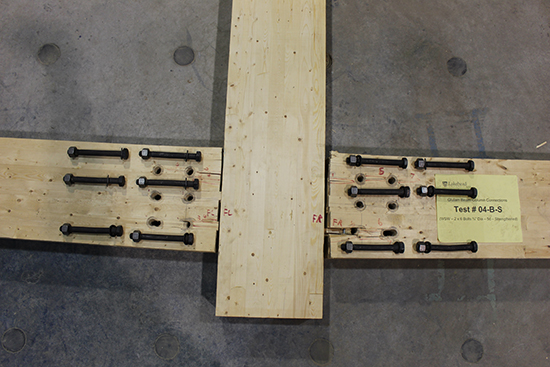
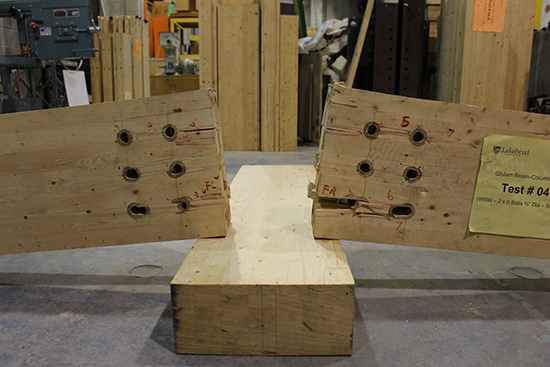
In their pioneer experimental investigation, 32 full-size beam-to-column test connections were subjected to monotonic loading simulating an intermediate column removal scenario. Eight test groups, each including four replicates of a wood-steel-wood glulam bolted connection configuration, were experimentally examined. The connections in four test groups were reinforced perpendicular to wood grain with self-tapping screws (STS). Test variables investigated were bolt end distance, number of bolt rows, and utilization of perpendicular-to-wood grain reinforcement. Each test assembly consisted of two glulam beam sections simply supported at their far ends and connected to an intermediate column that is inversely subjected to loading.
The authors reported that in the event of a column removal, the examined connections behaved in a semirigid manner with considerable moment-resisting capacity, unlike typical beam-to-column timber connections that are assumed to be perfectly pinned. Moreover, experimental results also revealed that increasing the number of bolt rows from two to three rows, with each row having two bolts, increased the moment-carrying capacity of both unreinforced and reinforced connections with increments greater than those obtained by increasing the bolt end distance from four to five times the bolt diameter.
In summary, the Lakehead University study presented an in-depth evaluation of the maximum moment-carrying capacity, stiffness, and failure modes of glulam beam-to-column connections reinforced perpendicular to the wood grain with SWG ASSY VG Plus self-tapping wood screws. Remarkably, the STS-reinforced glulam connections manifested considerably increased moment-carrying capacities compared to the respective unreinforced connections by a factor ranging between 1.30 and 2.4. In a statement to Advances in Engineering, Professor Salem explained their results proved the ability of such glulam frame connections to redistribute the applied load and successfully transfer it to adjacent elements in case of column removal that could be caused by fire, explosion, or accidental damage. He also added that the allowance of timber as the primarily construction material for high-rise buildings up to twelve stories as what the latest version of the National Building Code of Canada (NBCC 2020) is permitting can increase the scope for glulam sections and broaden its spectrum of utilization in the mass timber construction in Canada.

Reference
Adam Petrycki, Osama “Sam” Salem. (2020). Structural Integrity of Bolted Glulam Frame Connections Reinforced with Self-Tapping Screws in a Column Removal Scenario. Journal of Structural Engineering: Volume 146 Issue 10.