Stretchable and wearable electronic devices are potential candidates for numerous applications including monitoring of human physiological activities, prosthesis, among others. To this note, extensive research has been conducted to improve their performance and energy consumption. Recent research has focused on powering these devices using advanced flexible energy storage equipment such as supercapacitors with high power density and fast charge and discharge properties. To date, significant progress has been made in engineering intrinsically stretchable and compressible supercapacitors to meet the desirable energy requirements in various practical applications. Unfortunately, developing an extremely intrinsic stretchable and compressible supercapacitors with higher compression resistance, good capacitance retention during large deformations remains a challenge, thus limiting their practical applications in certain conditions.
Typically, an intrinsic stretchable and compressible supercapacitor consists of a stretchable hydrogel electrolyte sandwiched between two electrodes. The capacitance retention of the supercapacitor highly depends on the hydrogel electrolytes. On the other hand, other shortcomings such the electrochemical performance degradation caused by the separation of the interface between the electrodes and the hydrogel during stretching can be addressed by using hydrogel electrolyte with strong adhesive forces between the electrolyte and the electrodes. Recently, a team of researchers at the Dalian University of Technology: Dr. Haoxiang Zhang, Dr. Wenbin Niu and Professor Shufen Zhang developed a new and extremely stretchable, sticky and conductive double-network ionic hydrogel electrolyte for constructing high-performance intrinsic ultra-stretchable and compressible supercapacitors. Their work is currently published in the journal, Chemical Engineering Journal.
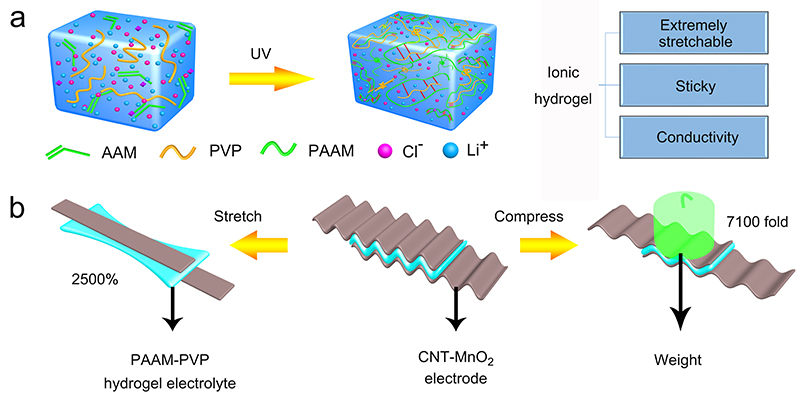
In their approach, the hydrogel electrolyte was developed via hydrogen-bonding interaction between a physically and chemically crosslinked polyacrylamide-polyvinylpyrrolidone (PAAM-PVP) double-network and LiCl electrolyte. Next, the double-network ionic hydrogel electrolyte was sandwiched between two activated carbon nanotube – MnO2 electrodes to form an intrinsic ultra-stretchable and compressive wrinkle-structured all-solid supercapacitor with desirable capacitance retention properties. Lastly, the resulting ultra-stretchable and compressible supercapacitor was explored for potential application in developing flexible energy storage devices.
The authors observed that the developed hydrogel electrolyte exhibited remarkable properties including extreme stretchability, high toughness, good conductivity and high compression recovery. Moreover, the adhesive force of the electrolyte and the electrode materials was significantly enhanced due to the salting-out effects induced by the strong hydration ability of the LiCl. On the other hand, the supercapacitor produced using this electrolyte was reported to have superior intrinsic stretchability, compressibility and remarkable specific capacity. As expected, the fabricated supercapacitor also showed good capacitance retention capacity of up to 87% at 2500% tensile strain and 90% at 7100-fold compression weight. Furthermore, it maintained over 97% and 104% capacitance after respectively undergoing stretching and compression for 6000 and 1000 cycles. It was worth noting that the resulting supercapacitor also exhibited great potential application in flexible energy storage devices.
In a nutshell, the study successfully constructed an ultra-stretchable and compressible supercapacitor based on extremely stretchable, sticky and conductive double-network ionic hydrogel electrolyte. Based on the results, the resulting supercapacitor showed superior mechanical properties as well as remarkable capacitance retention ability under both tensile strain and compression forces. Compared to other intrinsically stretchable supercapacitors, the wrinkled-structured all-solid supercapacitor maintained a higher capacitance value after undergoing stretching and compression deformations. In a statement to Advances in Engineering, the authors noted that the work provided useful insights into the synthesis of ionic electrolytes that would advance the field of flexible energy storage by paving the way for the development of highly stretchable and compressible next-generation solid-state energy storage devices.

Reference
Zhang, H., Niu, W., & Zhang, S. (2020). Extremely stretchable, sticky and conductive double-network ionic hydrogel for ultra-stretchable and compressible supercapacitors. Chemical Engineering Journal, 387, 124105.