
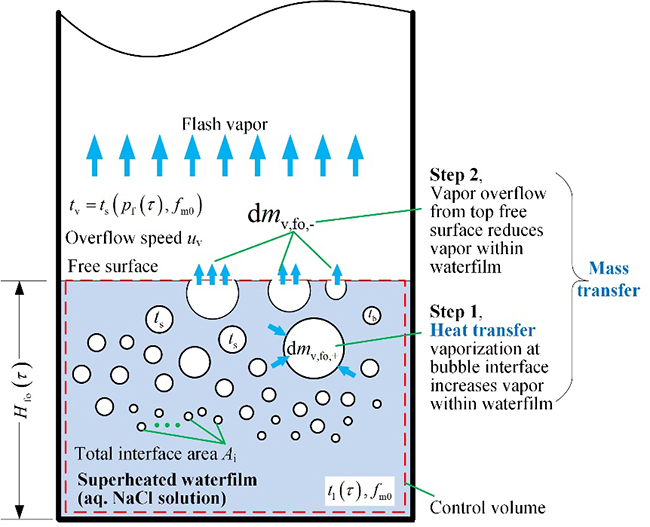
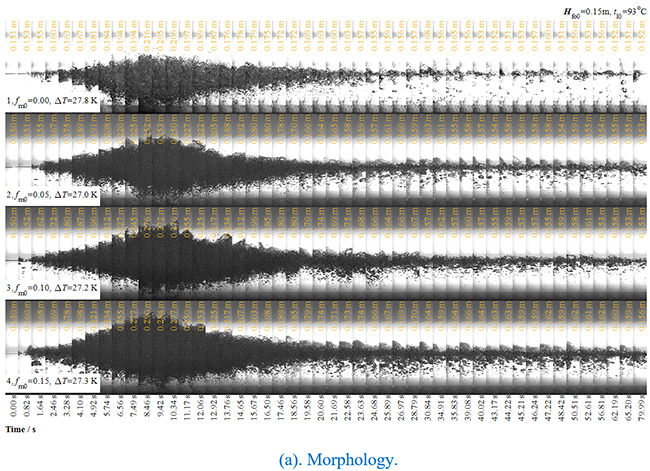
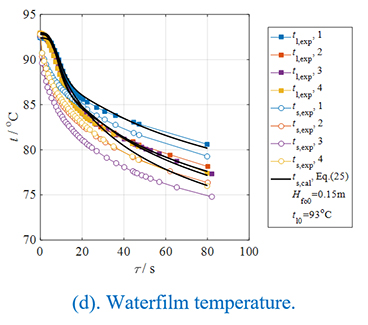
Flash evaporation is an evaporation phenomenon caused by a sudden pressure drop sufficiently below the saturation pressure. The flash evaporation rate is proportional to the difference between the saturated pressure and the equilibrium pressure. This phenomenon is widely used for desalination, concentration, desiccation, surface deposition, surface cooling, atomization, propulsion – among other applications. Flash can be classified according to the shape of the superheated liquid (i.e. droplet flash or spray flash) or depending on whether the superheated liquid has a macro velocity (i.e. static or dynamic). Static film flash is the most basic form of flash. A review of existing literature reveals that it is mainly from the evolution of water film temperature (tl) that most of these literatures studied the overall heat/mass transfer properties. Generally, such published literature suggests that, first, static film flash includes both heat and mass transfer and second, the heat/mass transfer during static film flash is not uniform, but tightly coupled with morphological evolution of water film.
A thorough review of related literature further reveals that few limitations still persist: notably, most studies have only focused on the fast evaporation stage (FES). More so, parameters they introduced could only describe the overall or average capacity of flash on heat/mass transfer during FES. Indeed, little attention has been paid to the transient heat/mass transfer properties during the entire process of static film flash. To this end, researchers from the Xi’an Jiaotong University in China: Professor Dan Zhang, Dr. Xiaoqu Han, Dr. Huihui Wang, Dr. Qingzhong Yang and Professor Junjie Yan, proposed a series of experiments, where they selected aqueous NaCl solution as working fluid and assessed its static film flash. Their work is currently published in International Journal of Heat and Mass Transfer.
Specifically, it is required that both the transient heat/mass transfer characters and height of water film be finely controlled; an aspect of the process which needs further understanding regarding their transient coupling relation. But study on it, especially during static flash of aqueous NaCl solution, is still limited. To unravel this, the team selected instant height/temperature of water film as a pair of characteristic parameters to study the transient heat/mass transfer properties during static film flash of aqueous NaCl solution though experiments at specific conditions.
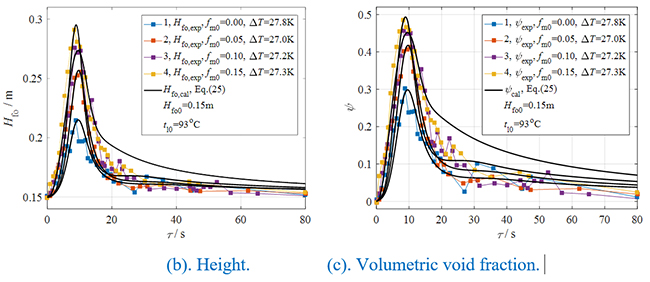
The authors reported the transient volumetric heat transfer coefficient highly depended on volumetric void fraction, but its change always lagged behind that of void fraction. Also, they noted that the transient overflow speed of flash vapor also depended on volumetric void fraction, but decreased significantly with increasing concentration of water film.
In summary, the study utilized aqueous NaCl solution with concentration of 0- 0.15 (mass fraction) as the working fluid to carry out a series of experiments of its static flash. On the basis of the obtained results, a calculation model for static film flash was set up. Remarkably, the model showed that the evolution of water film temperature/height could be computed simultaneously given the evolution of flash chamber pressure and other necessary initial conditions. In a statement to Advances in Engineering, the authors highlighted that their results would offer valuable insights for future studies focusing on similar ideas.

Reference
Dan Zhang, Xiaoqu Han, Huihui Wang, Qingzhong Yang, Junjie Yan. Experimental study on transient heat/mass transfer characteristics during static flash of aqueous NaCl solution. International Journal of Heat and Mass Transfer, volume 152 (2020) 119543.