
Combined effects of surface, Knudsen and molecular diffusion
The durability and longevity of cement-based materials are highly dependent on the transport rate of aggressive gases, mainly through diffusion. Gas diffusion can be classified into three, namely, molecular, Knudsen and surface diffusion. In cementitious materials, these mechanisms coexist, and the dominance of each changes with changes in the pore sizes. Unfortunately, their combined effects have not been fully explored in the literature. Gas diffusivity is a commonly used approach for estimating the resistance capability of cement paste for aggressive gas. Analysis based on the measured gas diffusivity has, however, yield contradictory results. Similarly, presently available empirical models for analyzing the gas diffusion mechanisms do not directly account for the morphology of cement pores since they cannot reflect the different diffusion mechanisms.
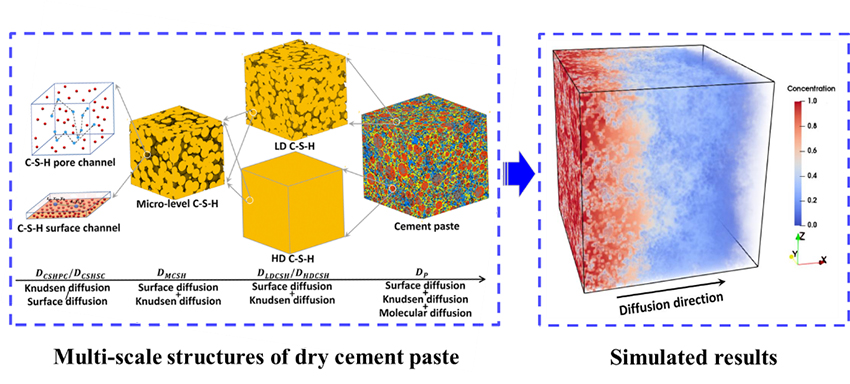
Numerical models have great potential for overcoming the above challenges. However, all existing numerical models treat the gas diffusion regime as molecular diffusion without considering the combined effects of surface and Knudsen diffusion, thus resulting in incorrect predictions. To address the problems above, Southeast University researchers: Cheng Liu (Ph.D. Student), Professor Zhiyong Liu and Professor Yunsheng Zhang developed a multi-scale model to simulate and analyze the effective gas diffusivity in dry cement paste, considering the combined effects of gas diffusion mechanisms. Their work is currently published in the journal, Cement and Concrete Research.
In their approach, the authors began by reconstructing the multi-scale structures using volume element representatives to capture the hierarchical pore structures of cement paste. The diffusivity was simulated by using the predictions of the down-scaling structure as input in the up-scaling structure. The gas diffusivity at each stage was predicted and simulated based on random walk, classical adsorption theory and Boltzmann methods taking into account the contribution of three phases: capillary pore, LD- and HD calcium silicate hydrate, as well as the effects of the local pore sizes. Finally, the feasibility of this approach was validated by carrying out cases studies using CO2, O2 and H2 and comparing the simulations and measurement results.
The research team reported that the surface and Knudsen diffusion plays a significant role in the gas diffusion and thus cannot be ignored or simplified as molecular diffusion when predicting gas diffusivity in cement paste. Diffusivity in the absorption layer was affected by various factors, including gas pressure, gas types and temperature. As the porosity increased, surface diffusion played an important role in the overall diffusion. However, the main diffusion regime in calcium silicate hydrate gradually became Knudsen diffusion with a further increase in the porosity. The simulated H2 diffusivities agreed well with the experimental results. In contrast, a little difference between the measured and simulated CO2 and O2 diffusivities were observed despite the similarity in the changing trend between measurements and simulations. The discrepancies between the measured and simulated results could be attributed to several factors including poor representation of hierarchical structures, curing conditions and varying experimental conditions.
In summary, the study is the first to propose a numerical model for quantifying gas diffusivity in dry cement paste, taking into consideration the combined effects of all diffusion regimes. Results showed that the effects of surface and Knudsen diffusion are significant and cannot be ignored or simplified as molecular diffusion. In a statement to Advances in Engineering, Professor Zhiyong Liu said that the multiscale framework would give more profound insights into gas diffusing mechanisms in cement-based materials.



Reference
Liu, C., Liu, Z., & Zhang, Y. (2020). A multi-scale framework for modelling effective gas diffusivity in dry cement paste: Combined effects of surface, Knudsen and molecular diffusion. Cement and Concrete Research, 131, 106035.