
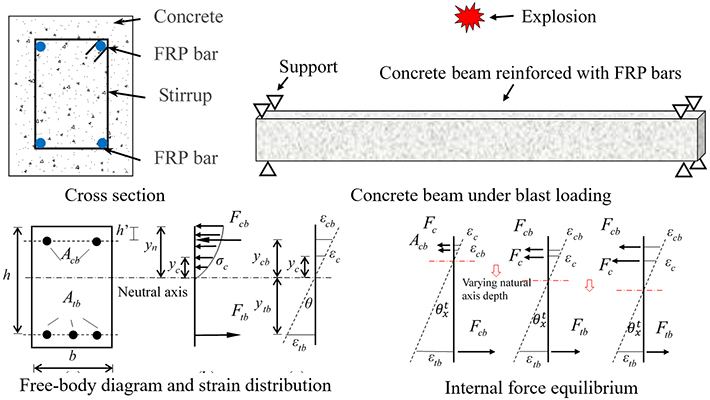
For the high tensile strength of Fiber Reinforced Polymer (FRP), FRP bars have gained interest in engineering applications as a potential replacement of steel bars to enhance the anti-explosion performance of reinforced concrete (RC) structures. The present theoretical analysis about dynamic response of concrete structure under blast loading are aimed at RC beams reinforced with steel bars. The inertia moment of beam is calculated approximately by the empirical formulae of bending moment and curvature. Since the mechanical properties of FRP bars are far away from that of steel ones, the empirical formulae of bending moment and curvature used in the present studies is inappropriate for the concrete member reinforced with FRP bars.
To this note, Dr. Yinzhi Zhou, Sanfeng Liu and Jiang Feng from the Army Engineering University of PLA together with Professor Hualin Fan from Nanjing University of Aeronautics and Astronautics proposed a novel Finite Difference (FD) model to predict dynamic responses of concrete members reinforced with FRP bars under explosion. Unlike the previous methods, this approach does not require the inertia moment of the beam or the empirical formula of the bending moment and the curvature. Instead, relationship between moment and curvature of the member is derived from the equilibrium of internal force in cross section taking into account the strain rate effects. The research work is currently published in the journal, Composite Structures.
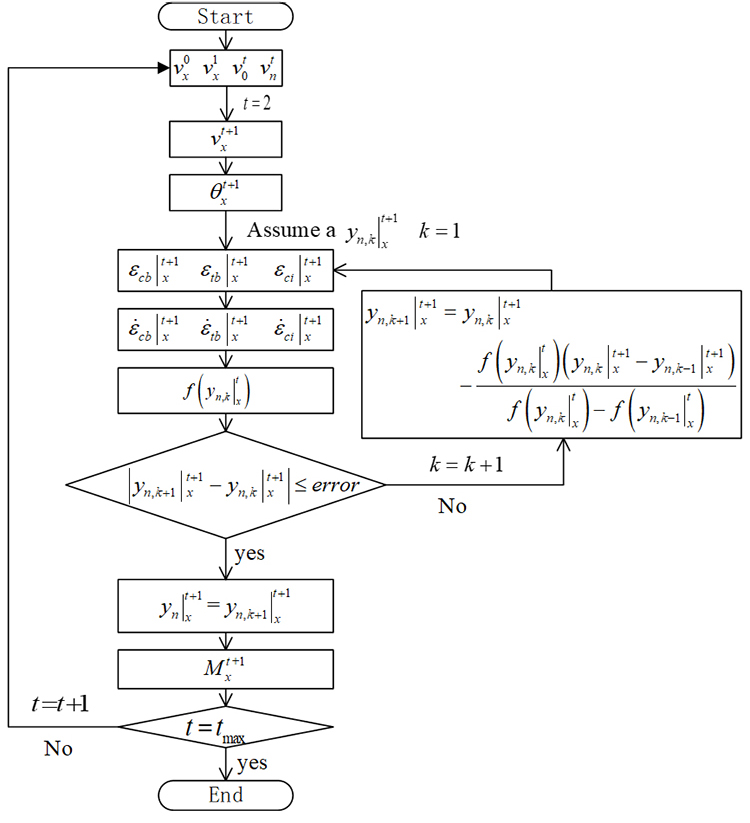
In brief, the authors utilized a layered-section based model to determine the nonlinear behavior of compressive concrete. The behavior of the reinforcing bar is derived from the equilibrium of the horizontal force of the cross section. Euler-Bernoulli’s beam theory was numerically solved using an explicit FD approach. Experiments involving concrete members reinforced with both steel bars and FRP bars were conducted to validate the feasibility of the proposed FD model.
Results showed that the proposed FD method can be used to analyses the dynamic response of concrete members reinforced by steel bars and FRP bars because it does not need the empirical formula of the moment-curvature relationship. It also proved efficient for calculation of the displacement curve at any section of the beam subject to arbitrarily distributed blast load as compared to the single-degree-of-freedom (SDOF) analysis method, which can only suitable for calculating the displacement curve at the mid-span of a beam subjected to regularly distributed load. Furthermore, the method was simpler and required less computational effort as compared to the Finite Element (FE) method, thus desirable for engineering applications.
Overall, the proposed finite difference method is much more convenient, accurate and can be used in predicting the dynamic response of flexural concrete member reinforced by steel bars and FRP bars. The FD analysis model produced consistent but more accurate results than the SDOF analysis and FE methods. The experimental validation results reported errors below 7% and 13% for concrete members reinforced with steel bars and FRP bars, respectively. Therefore, the improved finite-difference analysis is a promising method for accurate prediction of dynamic responses of concrete members reinforced with FRP bars.




Reference
Zhou, Y., Liu, S., Feng, J., & Fan, H. (2019). Improved finite difference analysis of dynamic responses of concrete members reinforced with FRP bars under explosion. Composite Structures, 230, 111518.