
The optical state of a material affects not only its visual appearance but also its possible applications. For example, maximizing optical absorption enables sensing, photodetection, steam generation, and the enhancement of solar cell efficiencies and printing ink darkness. In contrast, maximizing reflection is essential for optical mirrors, cavities, or diffractive elements, whereas high transmission is required for see-through applications such as smart windows or displays. Applications may additionally demand switching from one optical state to another, for example, from diffuse reflection to strong absorption, as in most printing, sensing, or data storage applications.
The authors presented a highly absorbing three-layer system that can switch from black to metallic appearance with high reflection and then to a fully transparent state. This multi-state switching is realized by first manufacturing a highly absorbing three-layer system and then modifying it by pulsed laser exposure. While engineering optical absorption and reflectance have been and still are extensively researched, this is possibly the first demonstration of the realization of a transparent state from an initially highly absorbing state.
A metal–insulator–metal (MIM) system is a class of structures maximizing absorption in the visible spectrum (VIS). It typically consists of a metallic base (mirror layer), dielectric spacer, and at least partially metallic top layers. The partially transparent and absorbing metallic top layer can be realized by various approaches, including lithography, to create a periodic pattern. This usually results in a rather narrow absorption band, which is detrimental to many applications. However, this absorption band can be broadened through smart optimization methodologies, often at the cost of the maximum achievable absorption. Another strategy to achieve broadband and near-perfect absorption is the use of a nanocomposite top layer consisting of metal nanoparticles embedded in a dielectric host material. One possible way to manufacture this nanocomposite layer experimentally is by coevaporation. Alternatively, laser-induced dewetting of an initially homogenous metal film can be used. The realization that it is possible to transform a homogenous metal film into nanoparticles inspired this work. Another important influence was the work of Li et al., who showed that near-perfect absorption is achievable for three-layer systems with a homogenous chromium top layer.
The advantage of nanocomposite material layers is that their complex refractive index can be easily tuned by varying the metal nanoparticle filling fraction. This is advantageous when the MIM is encapsulated in a high-refractive index material. In contrast, for surrounding media with low refractive indices, such as air or glass, near-perfect absorption can be achieved using homogenous chromium layers. Another possibility is to use platinum, which can achieve an optical performance comparable to that of chromium, has a high melting temperature, and does not oxidize; it is often the metal of choice for thermal photovoltaic applications. Here, we focus on using chromium as it is more economical than gold nanoparticle composites or platinum while providing high absorption in the VIS.
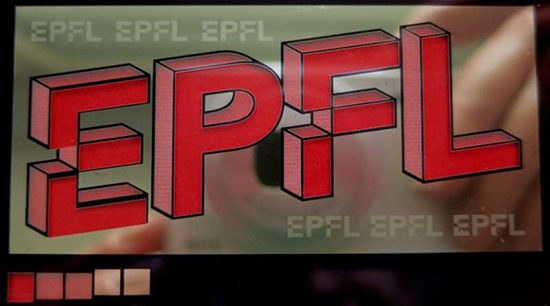
The researchers aimed to modify a three-layer MIM system that is to transform its initially black state gradually to a plurality of reflection and transmission states. These states included metallic or mirror-like, transparent, semitransparent, and matt-like states. This plurality of achievable states can enable applications in data storage, multi-state printing such as QR codes, and fabrication of diffractive optical elements that can simultaneously alter amplitude and phase. Any application that demands the realization of multiple states can benefit from this multi-state switching, but they restricted ourselves to a proof-of-principle for multi-state printing and demonstrated a large-area three-dimensional (3D) art image.
In summary, The research team manufactured three-layer systems that absorb more than 90% of the incident light in the VIS and thus have a black appearance. The measured absorption spectra of the initial black state agreed well with the simulation data. The black appearance was locally modified by focusing a λ = 1064 nm nanosecond pulsed laser to 50-micron sized spots. This allowed them to realize a six-state 3D artwork print with defined areas containing either a black, mirror-like, matt-like, or one of the three transparent states. Transparency was selectively tuned in three different grades by altering the raster strategy of the printing process. Realizing additional transparent states would be straightforward by further altering the rasterization. The influence of the substrate material and metallic bottom layer thickness on the process window of this novel multi-state process was determined and discussed in detail. The experiments were supported by numerical simulations, and the agreement between the two was excellent. We envision that the findings for the multi-state print presented here are readily transferable to other research areas, including the fabrication of novel diffractive optical elements by local modifications of its reflection, transmission, and phase properties.
Reference
Sebastian Mader and Olivier J.F. Martin, Engineering multi-state transparency on demand, Light: Advanced Manufacturing (2021). DOI: 10.37188/lam.2021.026