
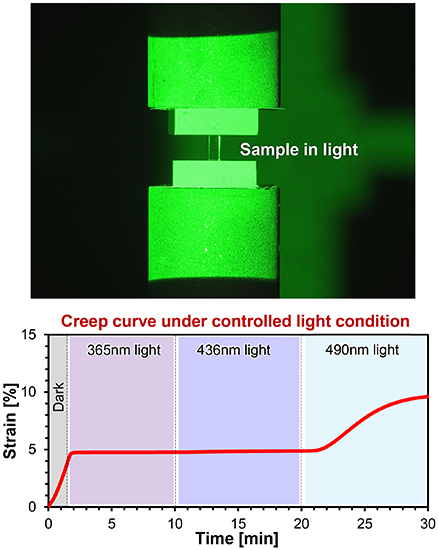
The deformation behaviors of inorganic semiconductors are highly affected by different light conditions. A more prevalent phenomenon in most single-crystal semiconductors is the photoplastic effect characterized by an increase in the flow stress with an increase in the light irradiation during deformation. Among the known inorganic semiconductors, the deformation of ZnS has attracted significant research attention. These materials have exhibited rather interesting deformation behavior characterized by extraordinary plasticity in darkness and brittle behavior under light irradiation. Consequently, ZnS has been reported to fracture after yielding when exposed to light, indicating deformation twinning. Nevertheless, despite the extensive study on the semiconductors, there are still contradicting reports on the cause and mechanism for the light-dependent mobility of the dislocations that dominate plasticity of crystals.
Generally, estimation of the effects of light irradiation on the density and mobility of the dislocations using conventional compression tests has remained challenging due to the significant effects of the applied stress on the density and mobility of the mobile dislocations. Therefore, more reliable and robust tests should be carried out to clarify the effects of light irradiation on the dislocation motion. In light of this, researchers at Nagoya University: Dr. Yu Oshima, Professor Atsutomo Nakamura, Dr. Tatsuya Yokoi, and Professor Katsuyuki Matsunaga in collaboration with Professor Peter Lagerlöf from Case Western Reserve University investigated the effect of light irradiation on the dislocation motion in ZnS via creep tests carried out under controlled light conditions. Their work is currently published in the journal, Acta Materialia.
In their approach, the creep tests on the single crystal ZnS were performed at room temperature and along the [001] direction. The different creep stages: initial transient stage and intermediate steady-state stage were discussed. All the creep tests were conducted by uniaxial compression in the air under constant load corresponding to the initial nominal stress. The testing machine was wholly covered with black curtains to prevent the entry of external light during the tests. A total of six different light conditions were used to understand the effects of light irradiation on the dislocation motion.
The authors observed creep deformation of the ZnS crystals at room temperature when the tests were conducted in darkness. Moreover, irradiating the samples with light having wavelengths of 365 nm or 436 nm led to a decrease in the strain rate even in cases where enough density of mobile dislocations was introduced before performing the creep test. The decline in the strain rate was attributed to the drastic change in the density and mobility of the mobile dislocations due to the interaction between the light-induced electrons and holes. Interestingly, a stop or reduction in the mobility of the moving dislocations was observed after the sample was irradiated with light, attributed to the accelerated interaction between the dislocations and free holes/electrons. Additionally, plastic deformation of ZnS occurred at a light wavelength of 490 nm and a light intensity of 4 µW/cm2, and no significant effects on the dislocation were reported when the photon energy was below the threshold value.
In summary, the study reported a room-temperature creep deformation of ZnS single crystals under controlled light conditions to investigate the effects of light irradiation on the dislocation motion. The findings showed that light-induced free electrons and holes have considerably longer lifetime in ZnS that can continue supporting the interaction with the electronic defects for a few minutes after removal of light. The results provided a thorough understanding of the effects of light irradiation on the dislocation motion that would further research on inorganic semiconductors.
Reference
Oshima, Y., Nakamura, A., Lagerlöf, K., Yokoi, T., & Matsunaga, K. (2020). Room-temperature creep deformation of cubic ZnS crystals under controlled light conditions. Acta Materialia, 195, 690-697.