The noble metal/oxide interface has been extensively studied. Among the known interfaces, it is considered one of the most crucial in many heterophase reactions like that in energy conversion due to its unique properties. Because of the inert nature of noble gases, the interfaces are important in explaining the effects of adjacent lattices on interface structures, particularly the effects of geometrical constraints of the lattices. To date, several geometric models, including the coincidence site lattice model and o-lattice model, have been developed to rationalize low-energy interfaces with preferred crystallographic orientation relationships (ORs). These models are based on the lattice structures and constraints of adjacent crystals. Generally, adjacent lattices can have similar or different lattice constants. Although an increase in the lattice mismatch results in a gradual loss of interface coherency, they are much more likely to maintain their rational orientation relationships.
In addition to geometrical constraints, the atomic and electronic interactions between the lattices can produce low energy interfaces leading to the differences between experimentally observed and geometrically predicted ORs. Such effects have been reported in a number of studies involving different noble metal/oxide interfaces. The existence of strong interactions between adjacent lattices and their associated effects on low-energy interfaces with rational ORs is also investigated in the literature. However, despite the considerable effects of strong interactions between oxides and noble metals on the noble metal/oxide interfaces, the extent to which the atomic interactions affect the interfaces and preferential ORs is poorly understood. Notably, interfaces exhibit preferential ORs with large lattice mismatches, and some of the ORs may be favored by the atomic and electronic interactions. Therefore, a thorough comprehension of Au-TiO2 (gold-rutile) interfaces and their preferential ORs could provide a better understanding of the effects of the atomic interactions and geometric constraints.
In a new study University of Manitoba researchers: Miss. Minghui Lin and Professor Guo-zhen Zhu together with Dr. Wei Zhou from Shanghai Jiao Tong University and Professor Xinfu Gu from the University of Science and Technology Beijing, conducted a comprehensive systemic study on the atomic structures and preferential ORs of gold-rutile interfaces using a combination of geometric model prediction and experimental investigations. Specifically, TEM and XRD analyses were performed on the structure and OR of the interactions of dewetted gold particles on single-crystal rutile supports. Their research work is currently published in the journal, Materials Characterization.
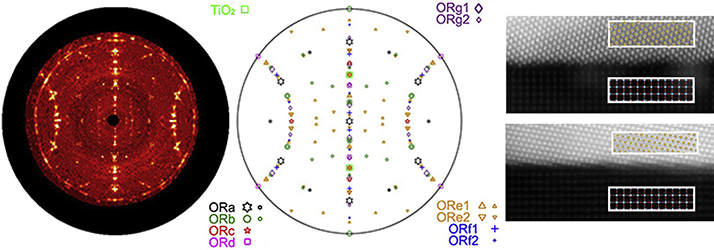
Previously, a total of four ORs were reported: ORa, ORb, ORc and ORd. In the new study, the researchers confirmed the existence of these ORs. In addition, they discovered interfaces with a few and new irrational ORs that were difficult to describe using low-index planes and directions. Additionally, the authors also observed atomic rearrangements at the interfaces that were closely associated with irrational ORs and those with low near coincidence sites (NCS) density. The effects of temperature on the distribution of OR were discussed and new ORs were observed at higher temperatures. Furthermore, the obtained ORs agreed with the theoretical predictions based on the geometrical constraints of adjacent lattices.
In summary, the study examined the preferential ORs at gold-rutile interfaces with thermally dewetted gold particles on rutile substrates. The preferential ORs at the gold-rutile interfaces were successfully predicted and subsequently validated. The results implied the potential application of geometric models for characterizing interfaces with large mismatch. The discovery of new ORs was partly explained through the NCS theory. In a statement to Advances in Engineering, Professor Guo-zhen Zhu, the corresponding author, explained that the employed scheme will advance studying different interfaces with irrational ORs.
Reference
Lin, M., Zhou, W., Gu, X., & Zhu, G. (2021). Gold-rutile interfaces with irrational crystallographic orientations. Materials Characterization, 176, 111116.