
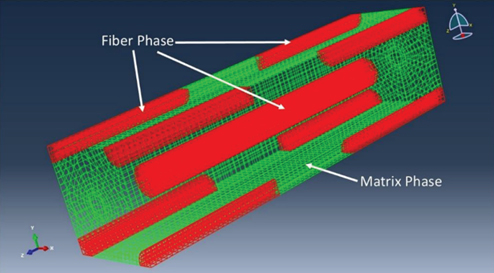
A fiber-reinforced composite (FRC) is a composite building material that consists of three components: i.e. the fibers as the discontinuous or dispersed phase, the matrix as the continuous phase, and the fine interphase region, also known as the interface. FRCs have found many applications in engineering credit to their superior properties compared to conventional materials. Noteworthy research has revealed that the viscoelastic property, as well as other material properties, of the composite depends directly on the mechanical response of the constituent materials of the various phases. Therefore, it is of pivotal importance to quantify the relationship between a specific constituent and the overall mechanical response of the composite. At present, the micro-mechanics analysis using the Representative Volume Element (RVE) approach implemented with the Finite Element Method has been widely used for computing material properties of unidirectional fibrous polymer matrix composites.
Existing literature has shown that the linearly viscoelastic relations serve as one of the key references in engineering designs of short fiber filled polymeric materials involved applications. Unfortunately, the RVE approach and related micromechanical studies are limited to the investigation of continuous fibrous composites. As such, it is evident that little attention has been given to viscoelastic RVEs of discontinuous fiber reinforced composites. On this account, researchers from the Department of Mechanical Engineering, School of Engineering and Computer Science at Baylor University: Professor Douglas E. Smith and PhD candidate Zhaogui Wang extended the RVE approach for evaluating the linear viscoelasticity of filled polymers. Their goal was to enhance the RVE approach so that it could be used to numerically characterize the viscoelastic creep behaviors of aligned discontinuous fiber reinforced composites. Their work is currently published in the research journal, Composite Structures.
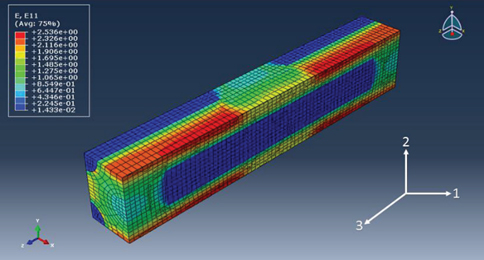
The researchers focused on assessing the effect of several parameters of the fiber inclusions on the creep compliances of a short fiber reinforced composite, where different fiber volume fraction, aspect ratio and packing geometry were explored and thoroughly probed. To prove the approach, an application of the RVE data using the ABAQUS user defined material subroutine was introduced, by which a homogeneously defined material that could yield equivalent creep response as the regular two-material defined RVE, was defined.
The computed results revealed that by increasing the volume of elastic fibers, all the compliance coefficients of the composite decreased. In addition, the authors reported that the computations also showed that the property enhancement from the reinforced fibers was highly dependent on the direction of fiber alignment, such that the fiber constituent mostly affected the property in the direction of the fiber orientation.
In summary, the study introduced a Finite-Element-Method-based micromechanics numerical algorithm, where a Representative Volume Element approach was applied to simulate the viscoelastic creep behaviors of aligned short fiber composites. Notably, the authors established that the fiber aspect ratio had a significant influence on longitudinal axial compliance coefficient in such a way that by increasing the aspect ratio, a decrease in the compliance property would be experienced. In a statement to Advances in Engineering, Professor Douglas Smith, the lead author explained that their customized subroutine was time-saving and suitable in analyzing the viscoelastic behaviors of a complex finite element domain made of a short fiber reinforced composite, as the separate meshing of the fiber and the matrix phases was no longer required.


Reference
Zhaogui Wang, Douglas E. Smith. Numerical analysis on viscoelastic creep responses of aligned short fiber reinforced composites. Composite Structures, volume 229 (2019) 111394.