The studies on hydrogen permeation using different techniques have arrived at the conclusion that hydrogen migration in metals is generally enhanced along the grain boundaries. This non-trivial result was in a clear contradiction with the experimental and theoretical data that only diffusion of substitutional atoms can be enhanced along the grain boundaries or dislocations, whereas the both of these lengthy crystal lattice defects are the traps for interstitial atoms decreasing thereby their diffusivity. Substantial experimental evidence for non-diffusional character of the enhanced grain boundary flux of interstitial atoms is still lacking.
The group of scientists led by Professor Valentin Gavriljuk and including Dr. George Mogilny, Dr. Vladyslav Shyvaniuk, Dr. Sergey Teus from G.V. Kurdyumov Institute for Metal Physics and Dr. Ljubomyr Ivaskevych from G.V. Karpenko Physical-Mechanical Institute of National Academy of Sciences of Ukraine investigated the occurrence of plastic deformation during cathodic charging in metals and its role in the enhanced hydrogen flux along the grain boundaries of metals. Their work is currently published in the research journal, Acta Materialia.
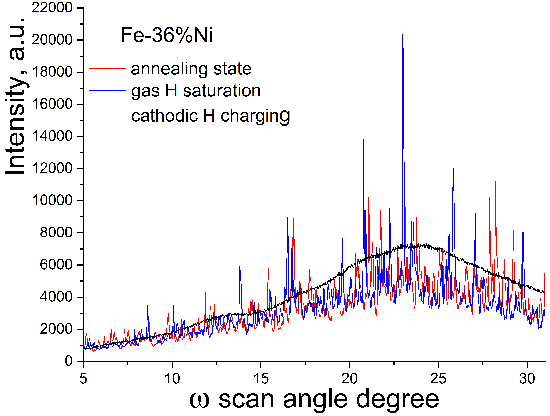
In their approach, the research team utilized a Fe-36Ni alloy because of its high hydrogen solubility and diffusivity properties. Using the omega scan X-ray diffraction technique, the effects of the electrolytic hydrogen charging on the crystalline structure of the annealed polycrystalline material was investigated and compared to that of gaseous hydrogenation. By analyzing the experimental data and the available literature data, they also discussed in detail whether enhanced hydrogen flux along the grain boundaries might be due to the hydrogen transportation by moving dislocations.
The authors observed that the electrolytic hydrogen charging leads to plastic deformation which increases density of dislocations and causes crystallographic texture. In contrast, the crystal structure remained unchanged during gaseous hydrogen charging due to the absence of plastic deformation, see Fig. 1.
As such, gaseous charging appeared to be the most suitable method for uncovering the grain boundary hydrogen diffusivity in polycrystalline metals. Notably, the stresses induced by the hydrogen concentration gradient were considered to be the only reason for plastic deformation. By analyzing and comparing the experimental data with the available literature information on hydrogen diffusion, the authors confirmed hydrogen transport by moving dislocations to be the underlying mechanism of enhanced hydrogen flux along the grain boundaries.
In summary, the study explored the effects of both gaseous hydrogenation and electrolytic hydrogen charging on the crystalline structure of Fe-36Ni alloy. Results provided evidence that plastic deformation is caused by electrolytic hydrogen charging. Moreover, hydrogen transport by sliding dislocations was identified as the primary mechanism for enhanced hydrogen flux at the grain boundary. In a statement to Advances in Engineering, by Professor Valentin Gavriljuk said their investigation provided useful insights that would benefit future studies on different metals.
Professor Valentin Gavriljuk: Born in 1938. Graduated on physics of metals at Kiev Technical University in 1960. Postgraduate at G.V. Kurdyumov Institute for Metal Physics, IMP, in 1962 to 1965 and PhD in 1966. From 1966 to 1988: young scientific researcher, senior scientific researcher and leading scientific researcher at IMP. Doctor hability in 1986, professor in 1989 and head of department of physical principles for design of steels and alloys at IMP since 1989 to 2015. Principal scientific researcher since 2015.
Current scientific interest: atomic interactions and phase transformations in Fe-, Ni- and Al-based solid solutions; mechanisms of hydrogen embrittlement in engineering materials.
Awards and fellowships: 1993 – state prize of Ukraine in the field of science, 1995 – honoured scientist of Ukraine, 2003 – Kurdyumov prize of National Academy of Sciences of Ukraine, 2003 – Doctor honoris causa at Helsinki University of Technology ( Aalto University since 2005), 2008 – award of journal “Steel Research International” for the best article in 2007; 2009 – diploma of Ukrainian State Parliament “For great services to Ukrainian People”; 2010 – G.V. Kurdyumov medal “For achievements in the physical metal science” set up by Institute for solid state physics, Rusian academy of Sciences, and Central Institute of Ferrous Metallurgy, Moscow, Russia; 2013 – medal of National Academy of Sciences of Ukraine “For training of young scientists”. 2018 – Diploma of Ukrainian government “For personal contribution to progress in native science and strengthening of scientific-technical potential of Ukrainian state”.
Reviewer for journals: Phys Stat Sol (a); Mat Sci & Eng A; Scripta Mater; Acta Mater, Comp Mat Sci; Intern J Hydrogen Energy; J Phys Ghem Solids; J Mater Sci; Mater Trans A etc.
Member of editorial boards: Metal Physics and Advanced Technologies; Exploratory Materials Science Research.
Dr. Ljubomyr Ivaskevych graduated from the Faculty of Physics of Lviv National University with a degree in physics, physics teacher. Since 1978 he has been working at the Institute of Physics and Mechanics of the National Academy of Sciences of Ukraine, now as a senior researcher. In 1987 he defended his dissertation on “The role of structure in the formation of mechanical properties of austenitic steels and alloys in gaseous hydrogen at high pressures and temperatures.”
He deals with the issues of hydrogen materials science of chromium-nickel and martensitic and austenitic steels and chromium-nickel-cobalt cast and powder heat-resistant alloys. In particular, studies of flooding of metals from hydrogen-containing gases at pressures up to 60 MPa and temperatures up to 1100 K, the effect of hydrogen on phase and structural transformations during loading, on mechanical properties under short-term static tension, low-cycle tensile and bending, on static and cyclic crack resistance of metal materials.
The study of mechanical properties, long-term strength, corrosion and hydrogen strength, structural stability of cast nickel alloys allowed to recommend them for the manufacture of working and nozzle turbine blades of modern and promising gas turbine engines developed by GP NPKG “Zorya” – “Mashproekt” (Nikolaev).
Dr. George Mogilny: Born in 1977. Received his BSc (1999) and MSc (2001) degrees on applied physics at National Technical University of Ukraine and PhD on solid state physics in 2010 at G. V. Kurdyumov Institute for Metal Physics, IMP, National Academy of Sciences of Ukraine. Currently, senior scientific researcher at IMP. Specializes in structural studies and X-ray diffraction of solids. Current interests: hydrogen embrittlement and hydrogen-induced TRIP effect in austenitic steels and alloys.
Awards: Prize of President of Ukraine for Young Scientists (2012).
Dr. Vladyslav Shyvaniuk: Born in 1975. Graduated at Physics Faculty of the Taras Shevchenko Kyiv National University in 1996. During subsequent work at department of physical principles for design of steels and alloys in G.V. Kurdyumov Institute for Metal Physics, passed all the stages of career growth from an engineer to the head of department (now – department of physics of structural materials). In 1998, for his scientific achievements he Received a scholarship from the French Government in 1998 and another Scholarship from President of Ukraine in 2002. Obtained his PhD and doctor hability diplomas in 2003 and 2016, respectively. Awarded by the Prize of Ukrainian President for Young Scientists in 2005. In 2005-2006 worked as a postdoc at University of Sciences and Technologies, Lille, France, and in 2009 to 2011 as an associate professor at Kyushu University, Japan.
His current research interests include hydrogen embrittlement of alloys, cryogenic treatment of engineering materials, Al-based structural alloys, etc.
Dr. Sergey Teus: Born in 1982. Graduated as bachelor on applied physics in 2003 at Kiev Technical University. Since 2003 to 2005 studied applied physics and mathematics at the Kiev branch of Moscow Institute of Physical Engineering, MIPE, obtaining the Masters’ degree. In 2005 to 2007, the postgraduate at MIPE, where his PhD thesis focused on the physics of metals. In 2019, doctor hability specializing on physics of metals. Currently, senior scientific researcher at G.V. Kurdyumov Institute for Metal Physics NAS of Ukraine.
His specialization includes ab initio calculations of atomic interactions, molecular dynamics, and experiments using mechanical spectroscopy. The research interest is hydrogen embrittlement of metals. Awards and Fellowships: Prize of Ukrainian Parliament, 2009, Alexander von Humboldt Foundation research fellowship for postdoctoral researches, Germany, 2009 to 2011, and a French Embassy Scholarship Program in 2012.
Reference
Mogilny, G., Shyvaniuk, V., Teus, S., Ivaskevich, L., & Gavriljuk, V. (2020). On a mechanism for enhanced hydrogen flux along grain boundaries in metals. Acta Materialia, 194, 516-521.