
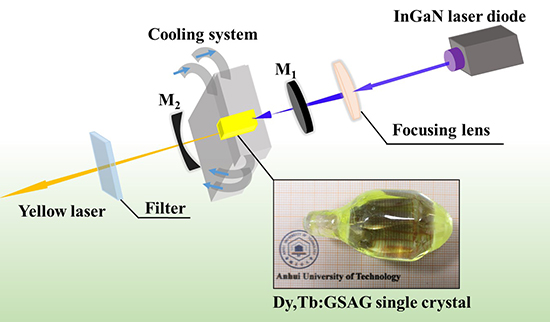
Yellow lasers with wavelength coverage range between 570 and 590 nm have received tremendous interest in recent years owing to their vast applications in medicine, visible laser displays, sodium laser beacons, temperature/wind laser LIDARs, and more. Non-linear frequency conversion methods are the basis for the realization of laser generation in this wavelength. Unfortunately, nonlinear frequency conversion techniques are often complicated, inefficient, and costly. This is why a simpler and reliable yellow laser generation system using laser diode pumping rare-earth doped laser materials to directly realize yellow lasers has been fashioned.
Trivalent Dysprosium Dy3+ is an effective active ion for laser diode pumped yellow laser generation owing to its active yellow laser emission. Unfortunately, the lack of an efficient high-power pumping source has continued to plaque progresses in yellow lasers on the basis of trivalent dysprosium doped materials.
The gadolinium scandium aluminum garnet crystal (Gd3Sc2Al3O12, GSAG) has been identified as a superior laser host exhibiting excellent thermal conductivity and sound physical-chemical properties. On top of this, its mixed structure can expand the inhomogeneous broadening of doped rare-earth ions spectra. Taking into account trivalent dysprosium’s narrow absorption band, this inhomogeneous broadening of the spectra can significantly improve the pumping energy’s absorption efficiency and curtail laser diode pumping source temperature dependency.
Research has uncovered that co-doping Tb3+ in the trivalent dysprosium-doped crystal has a potential of improving laser efficiency and decreasing yellow laser emission threshold. In light of this, associate professor Shoujun Ding, Hao Ren, Yong Zou, Wenpeng Liu and Professor Qingli Zhang of Anhui University of Technology, China, grew a high quality Dy3+ and Tb3+ co-doped gadolinium scandium aluminum garnet crystal (Gd3Sc2Al3O12) (Dy,Tb:GSAG) using Czochralski (Cz) technique. They also investigated the morphology of the defects in the crystal and trivalent dysprosium’s effective segregation coefficient in gadolinium scandium aluminum garnet crystal host. Their research work is published in the Journal of Materials Chemistry C.
The research team implemented the traditional Czochralski technique to grow a high-quality Dy3+ and Tb3+ co-doped gadolinium scandium aluminum garnet single crystal. They revealed the crystal morphology and effective segregation coefficient of trivalent dysprosium in gadolinium scandium aluminum garnet crystal (Gd3Sc2Al3O12) host using powder X-ray diffraction, single crystal X-ray diffraction, and energy dispersive spectroscopy respectively. They also implemented a chemical etching method to accurately investigate the dislocation defects in the as-grown crystal.
The authors observed that the as-grown crystal morphology belonged to the cubic system. They also determined the crystal’s thermal conductivity vs temperature, and at room temperature, they determined the crystal’s thermal conductivity to be 4.8 W m-1 K-1. The authors determined the absorption cross-section corresponding to the 6H15/2 – 4I15/2 transition of trivalent dysprosium to be 3.12 x 10⁻²¹ cm2, and the full width at half maximum for this absorption to be as broad as 18.5nm.
The researchers observed Tb3+ emission under 450nm excitation suggesting that resonance energy transfer between trivalent dysprosium and Tb3+ was achieved. The crystals emitted yellow and cyan color lights, at 450nm and 355 nm excitations, respectively. The outcomes of this study suggest that Dy3+ and Tb3+ co-doped gadolinium scandium aluminum garnet crystal (Gd3Sc2Al3O12) (Dy,Tb:GSAG) has potential applications in ultra-violent and blue light chip excited solid-state lighting and GaN blue laser diode excited all-solid state yellow lasers.


Reference
Shoujun Ding, Hao Ren, Yong Zou, Wenpeng Liu and Qingli Zhang. Single crystal growth and property investigation of Dy3+ and Tb3+ co-doped Gd3Sc2Al3O12 (GSAG): multiple applications for GaN blue LD pumped all-solid-state yellow lasers and UV or blue light chip excited solid-state lighting. Journal of Materials Chemistry C, issue 9 (2021), pages 9532–9538.