Juergen Biener, Subho Dasgupta, Lihua Shao, Di Wang, Marcus A. Worsley, Arne Wittstock, Jonathan R. I. Lee, Monika M. Biener, Christine A. Orme, Sergei O. Kucheyev, Brandon C. Wood, Trevor M. Willey, Alex V. Hamza, Jorg Weissmuller, Horst Hahn, Theodore F. Baumann.
Advanced Materials, Volume 24, Issue 37, pages 5083–5087, September 25, 2012.
Nanoscale Synthesis and Characterization Laboratory, Lawrence Livermore National Laboratory, 7000 East Avenue, Livermore, CA 94550, USA.
Institute for Nanotechnology, Karlsruhe Institute of Technology, 76021 Karlsruhe, Germany.
Joint Research Laboratory Nanomaterials, Technische Universitat Darmstadt, 64287 Darmstadt, Germany.
Institut fur Werkstoffphysik und -Technologie, Technische Universitat Hamburg-Harburg, Eissendorfer Stasse 42, 21073 Hamburg, Germany.
Institut fur Werkstoffforschung, Werkstoffmechanik, Helmholtz-Zentrum Geesthacht, Max-Planck-Strasse 1, 21502 Geesthacht, Germany.
Abstract
Polymer-derived, monolithic three-dimensional nanographene (3D-NG) bulk material with tunable properties is produced by a simple and inexpensive approach. The material is mass-producible, and combines chemical inertness and mechanical strength with a hierarchical porous architecture and a graphene-like surface area. This provides an opportunity to control its electron transport and mechanical properties dynamically by means of electrochemical-induced interfacial electric fields.
Copyright © 2012 WILEY-VCH Verlag GmbH & Co. KGaA, Weinheim
Go To Journal
http://onlinelibrary.wiley.com/doi/10.1002/adma.201202289/abstract
Additional Information
3D Nanographene – Dynamically Tunable Bulk Materials
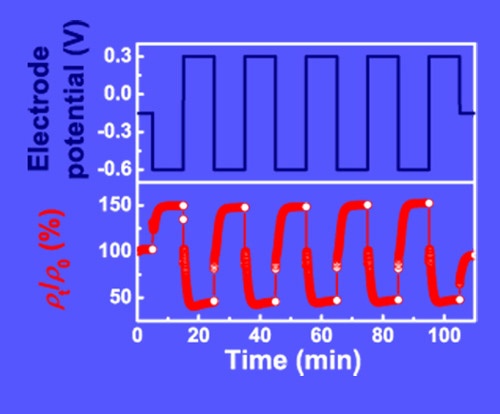
Lawrence Livermore researchers have recently developed a new bulk material whose physical properties can be dynamically changed by electrochemical-induced interfacial electric fields. The scientists came up with a method to fabricate mass-producible graphene-based bulk materials from low-cost polymer-derived carbon foams by selectively removing carbon atoms from a network composed of both unstructured carbon and graphitic nanoplatelets. The new technique is inexpensive, scalable, and yields mechanically robust, centimeter-sized monolithic samples that are composed almost entirely of interconnected networks of single-layer graphene nanoplatelets. The ultra-high surface area of this 3D graphene bulk material provides an opportunity to explore the concept of dynamically tunable bulk materials using interfacial charging. For example, reversible electrical conductivity changes of several hundred percent and macroscopic strain amplitudes of more than two percent have been achieved by injection/depletion of less than one percent of an electronic charge per carbon atom. These findings open the door to new 3D applications of graphene including low voltage all-carbon actuator and bulk field effect transistor technologies. The material is also very promising for energy storage in super-capacitors where energy is stored by polarization of the graphene electrode/electrolyte interface, or as electrically conductive network in fuel cell, battery, or capacitive desalination applications.